Showing posts with label MUKESH AMBANI. Show all posts

Wednesday, July 15, 2020

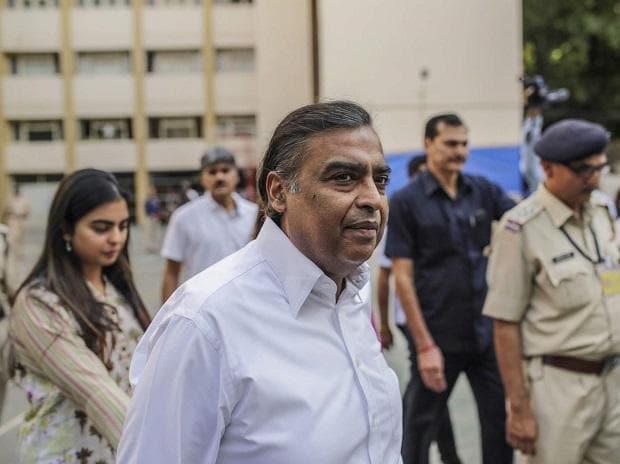
Mukesh Ambani is world's 6th richest, pips Elon Musk, Google founders


The chairman of Reliance Industries, whose wealth surpassed Warren Buffett's last week, is now worth $72.4 billion, according to the Bloomberg Billionaires Index.


Mukesh Ambani surged past Silicon Valley tech titan Elon Musk as well as Alphabet co-founders Sergey Brin and Larry Page to become the world’s sixth-richest person.

The chairman of Reliance Industries, whose wealth surpassed Warren Buffett’s last week, is now worth $72.4 billion, according to the Bloomberg Billionaires Index. Shares of the conglomerate have more than doubled from a low in March as its digital unit got billions in investments from companies including Facebook, Silver Lake and, most recently, Qualcomm.

Ambani’s energy empire is slowly shifting to e-commerce, with tech giants seeking to take a piece of India’s fast-growing digital business. The world’s second most-populous nation has seen a spike of foreign interest in its economy, especially from Silicon Valley, and Google said on Monday it will spend $10 billion in the coming years to help accelerate the adoption of digital technologies in the country.


After a drop in US tech shares on Monday, Page’s fortune now stands at $71.6 billion, while Brin’s is at $69.4 billion and Musk is worth $68.6 billion. Buffett’s net worth dropped last week after he gave away $2.9 billion to charity.


Tuesday, July 14, 2020

Google is in advanced talks to invest $4 billion in Jio Platforms


Global tech leaders from Facebook to Intel are looking for multiple ways to grab a slice of the action in the South Asian country, where millions of first-time internet users are added every month.


Google is in advanced talks to buy a $4 billion stake in Mukesh Ambani’s technology venture, people familiar with the matter said, seeking to join rival Facebook in the chase for growth in a promising internet market.

The Mountain View, California-based titan has been discussing the investment in Reliance Industries’ digital arm, Jio Platforms, the people said, asking not to be identified because the information is private. An announcement could come as soon as the next few weeks, according to the people.

Jio is at the centre of the Indian tycoon’s ambition to transform his energy conglomerate into a homegrown technology behemoth — something on the lines of China’s Alibaba Group Holding. The venture has turned into a magnet for Silicon Valley investors, attracting almost $16 billion from Facebook to KKR & Co. in the past three months. Should the talks with Google result in a deal, that would further burnish Jio’s credentials in its push to upend online retail, content streaming, digital payments, education and health care in a market of more than a billion people.

Global tech leaders from Facebook to Intel Corp. are looking for multiple ways to grab a slice of the action in the South Asian country, where millions of first-time internet users are added every month. Jio Platforms, which boasts almost 400 million users through its wireless network, offers the largest base of such users who are increasingly buying merchandise online and downloading music and video, using cheap phones and Jio’s own cut-price data services. An arm of Qualcomm Inc. was the latest in Jio’s growing list of investors, who also include Intel Capital, Silver Lake and Mubadala Investment. As of July 12, Reliance had sold 25.2 per cent of Jio, valuing the venture at $65 billion.


Wednesday, June 24, 2020

Pompeo declares Reliance Jio 'clean' for spurning Huawei telecom gear


Reliance Industries Chairman Mukesh Ambani had told US President Donald Trump during his February visit to India that Jio was the only network in the world to not have a single Chinese component.


US Secretary of State Mike Pompeo has declared Reliance Jio a "clean" network for not using the Chinese company Huawei's equipment, keeping it safe from Beijing's intelligence intrusions.

Listing Jio among the "world's leading" telecom operators, Pompeo said on Wednesday that it was one of the "Clean Telcos" for spurning Huawei, which he called a part of the "Chinese Communist Party (CCP) infrastructure."

Reliance Industries Chairman Mukesh Ambani had told US President Donald Trump during his February visit to India that Jio was the only network in the world to not have a single Chinese component.

Jio is reportedly trying the 'swadeshi' route for 5G and has applied to the Department of Telecommunications for permission to carry out lab tests for the technology without third-party participation.

Facebook announced a $5.7 billion investment in Jio in April.
Pompeo said that by Jio along with some other Canadian, British and French telecoms was "disconnecting from the Chinese Communist Party infrastructure" by not using Huawei equipment.

"They are rejecting doing business with tools of the CCP surveillance state, companies like Huawei," he added while speaking to the media before the release of the State Department's annual terrorism report.

The US campaign against the Chinese telecom equipment manufacturer over fears its gear can be used for espionage has intensified as the company begins its push into the next-generation 5G networks.

Working to complete contours of Saudi Aramco deal, says Mukesh Ambani


The deal was to be concluded by March 2020 but has been delayed.


Oil-to-telecom conglomerate Reliance Industries Ltd (RIL) on Tuesday said it is working to complete contours of a USD 15-billion deal with Saudi Aramco but did not give a timeline for its completion.

Richest Indian Mukesh Ambani in August last year announced talks for sale of 20 per cent stake in the oil-to-chemical (O2C) business, which comprises its twin oil refineries at Jamnagar in Gujarat and petrochemical assets, to the world's largest oil exporter. The deal was to be concluded by March 2020 but has been delayed.

"Reliance is working to complete the contours of a strategic partnership with Saudi Aramco," Ambani said in the firm's latest annual report without giving timelines.
The partnership with Aramco would give Jamnagar refineries "access to a wide portfolio of value-accretive crude grades and enhanced feedstock security for a higher oil-to-chemicals conversion," he said.

Reliance executed on the next phase of its growth journey in 2019-20, forging transformative partnerships across businesses.

"Reliance and Aramco share a common outlook and vision on the evolution of the business in the future with emphasis on higher oil-to-chemicals conversion," the firm said in the annual report.

Also, the firm said it has formed a 51:49 joint venture with BP plc of the UK for automobile and aviation fuel business in India.


Tuesday, June 16, 2020

Jio has a 'Sign in with Apple' like service but for Reliance employees only


Jio SecureID works through a dedicated app of the same name, which is available on Apple's App Store and Google's Play Store to download


Reliance Jio is working on a new digital authentication and authorisation service, which would allow smartphone users to sign-in on apps and websites through a single pin. Named Jio SecureID, the service is currently available in beta testing to select Reliance group employees. The Jio SecureID is expected to be part of Jio Platforms services, which are available for everyone to use and explore.

The Jio SecureID seems similar to ‘Google Sign-in’ and ‘Sign in with Apple’ services. However, it works through a dedicated app (Jio SecureID), which will be available on Apple’s App Store and Google’s Play Store to download. The app allows users to create four-digit and six-digit pins, which can be used to sign-in on apps and portals. To generate pins, however, you need a valid mobile number and the authentication is done through Aadhaar.

“Your Aadhaar card is the identity document against which we are issuing your Jio SecureID. We will be adding other alternate identity documents you could use eventually,” According to FAQs posted on service landing page on Jio portal.
Unlike other Jio Platforms services, which require Jio mobile number, the Jio SecureID works with any valid 10-digit mobile number from any telecom operator.

“Jio SecureID is being made available for Reliance group employees and can be used to log in to Reliance group apps or portals and approve/authorize transactions or documents. Employees don’t need to remember different user names or passwords, the only thing needed is mobile with Jio SecureID app,” according to a service page on Jio portal.


Tuesday, June 2, 2020

RIL in talks with West Asian sovereign funds for Jio Platforms: Report


Abu Dhabi and Saudi groups slated to invest about $1 billion into Jio Platforms Ltd, says report.


Three leading Middle Eastern sovereign wealth funds are in advanced talks to invest in Reliance Industries Ltd.’s digital arm, Bloomberg News reported quoting unnamed sources.

Abu Dhabi’s Mubadala Investment Co. is slated to invest about $1 billion into Jio Platforms Ltd. and an announcement could come as soon as this week, said the news agency, following similar reports last week. Reliance, backed by India’s richest man Mukesh Ambani, is also in discussions with Abu Dhabi Investment Authority and Saudi Arabia’s The Public Investment Fund.

Jio Platforms, which houses music and movie apps as well a Reliance's telecommunication venture Jio Infocomm, has secured a massive $10 billion from investors including Facebook Inc in May.

Reliance and its subsidiaries have invested over $2 billion in its four-pronged strategy to become a technology powerhouse, Business Standard reported on Monday.

The strategy includes spending over $1.6 billion on buying stakes in 24 tech firms across the US, UK, and India; winning 30 US patents out of the 53 it applied for, mostly in telecom and radio communications; and developing in-house tech in artificial intelligence, machine learning, block chain, virtual reality, big data, and 5G. Also, the ‘Gennext’ programme is providing venture capital support and mentoring to 150-odd companies across fields ranging from finance and retail to e-procurement, logistics, non-invasive testing of fruit quality, and delivering Indian products to global consumers, among others.


Thursday, May 28, 2020

Is India's richest man Mukesh Ambani betting on US-China tech war?


US-traded Chinese technology firms such as JD.com and NetEase are looking for an alternative home closer to the mainland in case tensions between Washington and Beijing escalate.


Petrochemicals czar Mukesh Ambani plans to list his fledgling digital business overseas, Bloomberg News reported Tuesday, citing people with knowledge of Jio Platforms’s initial public offering, which is planned for the next 12 to 24 months.

Going to the New York Stock Exchange or Nasdaq would make sense. US-traded Chinese technology firms such as JD.com and NetEase are looking for an alternative home closer to the mainland in case tensions between Washington and Beijing escalate, as my colleague Nisha Gopalan wrote this week. Alibaba held a secondary listing in Hong Kong in November. With Washington considering a range of sanctions against Chinese officials and firms as punishment for Beijing’s crackdown on Hong Kong, now may be the perfect time to pitch American investors on the potential of the other internet market with a billion-plus people.

A splashy overseas foray will be an unusual step for a family that brought the retail equity culture to India. Dhirubhai Ambani, Mukesh’s late father who founded the empire, booked a football stadium in Mumbai in 1985 to hold a shareholders’ meeting for the polyester textile maker that he had floated eight years earlier. But then, Mukesh Ambani is already moving old furniture around as he pivots flagship Reliance Industries away from an oversupplied energy and chemicals market. At the same time, he’s beefing up the balance sheet after a seven-year, $100 billion debt-fueled expansion. A big chunk of that was for Jio, the wireless carrier that has become India’s largest in less than four years.

A $7 billion rights issue, Reliance’s first in three decades, buttressed by more than $10 billion raised in a month from the sale of shares in unlisted Jio Platforms may help cut the company’s $20 billion of net debt to zero before Ambani’s March 2021 target.

Monday, May 11, 2020

Reliance Industries may rewrite recent history of rights issues: Here's how


The previous large rights issues by companies have typically had a strike rate of 25-28% from shareholders, which includes the top 10 rights issues including those of the Tata group.


The Rs 53,125 crore rights issue of Mukesh Ambani's Reliance Industries Limited (RIL) is scheduled to open on May 14 might rewrite the recent history of "rights". Shares of the company gained 3.4 per cent at Rs 1,615 on the BSE on Monday after the date was fixed for determining shareholders eligible to apply for its rights issue. The stock was trading close to its record high of Rs 1,618, and recovered 84 per cent from its 52-week low of Rs 876 on March 23.

The previous large rights issues by companies have typically had a strike rate of 25-28 per cent from shareholders, which includes the top 10 rights issues and all the large rights issues of the Tata group.

The Bharti Airtel rights issues launched in May 2019 with a size of Rs 24,939 crore got 15 per cent response from shareholders with 27,301 applications on the total number of shareholders at 186,000.

The Vodafone Idea issue in April last year received 26 per cent applications. The issue size was Rs 25,000 crore and out of the 339,000 shareholders, 87,248 shareholders applied.


The issue of Tata Steel to the tune of Rs 12,704 crore received 39 per cent applications from shareholders as of the total of 740,000 shareholders, the number of applications was 291,000.

The Tata Motors issue in 2015 to the tune of Rs 7,497 crore received 25 per cent applications as 90,631 shareholders applied out of 366,000.
The Tata Power issue in March 2014 got 38 per cent applications as 89,840 applied out of 236,000 for an issue size of Rs 1,993 crore.

The TV18 issue in 2012 for Rs 2,700 crore got a 21 per cent response from 12,976 shareholders out of 60,373.


Friday, May 8, 2020

RIL sells another 2.32% in Jio, this time to Vista Equity for Rs 11,367 cr


This is Jio's third major announcement in three weeks after it previously sold stakes to Facebook and Silver Lake.


Reliance Jio Platforms, part of Mukesh Ambani-controlled Reliance Industries group, has sold a 2.32 per cent stake to US-based private equity firm Vista Equity on a fully diluted basis for Rs 11,637 crore. This is a third major equity deal for Jio Platforms in three weeks — it previously sold a 9.9 per cent stake to Facebook for Rs 43,534 crore, and then 1.5 per cent to Silver Lake for Rs 5,655 crore.

The Vista Equity investment has valued Jio Platforms at an equity value of Rs 4.91 trillion and an enterprise value of Rs 5.16 trillion. Vista’s investment will make Vista it “the largest investor in Jio Platforms behind Reliance Industries and Facebook”. Jio Platforms has now raised Rs 60,596.37 crore from leading technology investors in less than three weeks.

Vista is a global investment firm focused on empowering and growing enterprise software, data and technology-enabled companies. It has more than $57 billion in cumulative capital commitments and its global network of companies collectively represents the fifth-largest enterprise software company in the world.

Commenting on the deal, Reliance Industries Chairman and Managing Director Mukesh Ambani said: “I am delighted to welcome Vista, one of the world’s marquee tech investors as a valued partner. Like our other partners, Vista also shares with us the same vision of continuing to grow and transform the Indian digital ecosystem for the benefit of all Indians. They believe in the transformative power of technology to be the key to an even better future for everyone. In Robert and Brian, whose family hails from Gujarat, I found two outstanding global technology leaders who believe in India and the transformative potential of a Digital Indian Society. We are excited to leverage the professional expertise and multi-level support that Vista has been offering to its investments globally for the benefit of Jio.”


Monday, May 4, 2020

After Facebook, Silver Lake to invest Rs 5,656 cr in Reliance Jio Platforms


The deal comes less than two weeks after Facebook made an investment of $5.7 billion to buy a minority stake in Jio Platforms.


American private equity firm Silver Lake has invested Rs 5,655.75 crore in Mukesh Ambani-owned Reliance Industries’ Jio Platforms. The deal comes less than two weeks after Facebook made an investment of $5.7 billion to buy a minority stake in Jio. The investment by Silver Lake values Jio Platforms at an equity value of Rs 4.9 trillion and an enterprise value of Rs 5.15 trillion, and represents a 12.5% premium on the equity valuation of the Facebook investment announced on April 22, 2020 – said Reliance Industries in a statement.

“I am delighted to welcome Silver Lake as a valued partner in continuing to grow and transform the Indian digital ecosystem for the benefit of all Indians. Silver Lake has an outstanding record of being a valuable partner for leading technology companies globally. Silver Lake is one of the most respected voices in technology and finance. We are excited to leverage insights from their global technology relationships for the Indian Digital Society’s transformation,” said Mukesh Ambani, Chairman and Managing Director, Reliance Industries.


Silver Lake is a prominent investor in technology space. The company has over $40 billion in combined assets under management and committed capital. Its investments include Airbnb, Alibaba, Ant Financial, Alphabet’s Verily and Waymo units, Dell Technologies, Twitter and numerous other global technology leaders.


Thursday, April 23, 2020

Reliance Jio connects with Facebook for $5.7-billion equity deal


Investment values Jio Platforms at Rs 4.36 trn; US giant gets 9.99% stake, board seat; collaboration is non-exclusive.


Facebook and Reliance Jio hit the headlines early Wednesday morning, in a break from the daily lockdown news. Mark Zuckerberg announced in a Facebook post that the technology giant will acquire a 9.99 per cent stake in Jio Platforms Ltd (JPL) through a fresh issue of shares worth Rs 43,574 crore.

The deal values JPL—the holding company of Reliance Jio — at an enterprise value Rs 4.62 trillion.

JPL’s equity value works out to Rs 4.36 trillion after Facebook’s investment, making it the fifth most valuable company in the country, behind its parent Reliance Industries (RIL), Tata Consultancy Services, Hindustan Unilever, and HDFC Bank.

Considering the market value of RIL and JPL, the Street is valuing RIL’s remaining but core businesses of refining and petrochemicals and others such as retail at a lesser number of Rs 4.28 trillion. This makes JPL more valuable than the rest of RIL.
JPL, a fully-owned subsidiary of Reliance Industries Ltd, houses many digital platforms like Jio Saavn and Radisys, besides the biggest disruptor in the Indian telecom scene, Jio.

As part of the deal, Facebook will get a board seat in JPL and an observer seat without voting powers. At a concall, a couple of hours after the news broke, Facebook India CEO Ajit Mohan said, “the very fact that we are announcing the deal during Covid-19 is a reflection of our commitment to invest in the country.’’

However, both sides made it clear that they will continue to compete in many areas where they have their own digital products. For instance, while Jio Pay is already operational, Facebook is awaiting permission for its digital payment platform. Also, Reliance has Jio Chat, which competes with WhatsApp directly.

“We will collaborate, not integrate. And in some areas, we will also compete as we have our own product lines. The deal is also not exclusive,” said Anshuman Thakur, head of strategy at Reliance Jio. He also pointed out that Jio or JPL could go public, but only in the medium term, in about three to four years.

Facebook-Jio deal may see more foreign e-commerce firms flock to India


WhatsApp's integration into Jio's e-com platform holds the key: Experts


Some recent regulatory developments may have precipitated the Facebook-Jio deal. Going forward, this may increasingly prompt foreign e-commerce operators to consider setting up base in India, say legal and tax experts.

Pressure from the recently-expanded scope of Equalisation Levy that covers non-resident e-commerce platforms, the Reserve Bank of India’s (RBI’s) mandate that all data related to payments should be stored only in Indian systems, besides the rigours of an imminent Data Protection Law have played their part in shaping the Facebook-Jio deal, noted Tarun Jain, partner, BMR Legal.

The deal may not throw up any major tax issues, other than tax complexities associated with e-commerce business, said Abhishek Rastogi, partner at Khaitan & Co. The expanded scope of Equalisation Levy, as per the Finance Act 2020, is unlikely to influence the deal since most Jio platforms are likely to qualify as Indian e-commerce operator.


“It will, however, be interesting to watch the manner in which WhatsApp is integrated with these platforms and facilitates online transactions,” said Lokesh Shah, partner, L&L Partners.

Given the wide scope of Equalisation Levy, which also includes a facilitator such as WhatsApp service, the applicability will need to be examined based on the actual role of WhatsApp/ Facebook, Shah added.

Experts, however, point out that becoming an Indian tax resident could turn out to be a double-edged sword for foreign e-commerce players as it would expose the global income of such operators to tax in India.

Monday, February 24, 2020

India will become premier digital society: Mukesh Ambani at CEO Summit


He said the big change driving this transformation is the deepening of mobile networks which are working at a much faster pace than before.


Reliance Industries Chairman Mukesh Ambani on Monday said India is at the cusp of becoming a premier digital society, and will be among the top three economies of the world.

In conversation Microsoft Chief Executive Satya Nadella at the Future Decoded CEO Summit here, he said the big change driving this transformation is the deepening of mobile networks which are working at a much faster pace than before.

"It all kickstarted in 2014 when PM gave us the vision of Digital India... 380 million people have migrated to Jio's 4g technology," he said.

Pre-Jio, the data speed was 256 kbps; and post-Jio, it is 21 mbps, he pointed out.
Referring to US President Donald Trump's visit to the country, Ambani said India is much different than what it was during the visits of his predecessors Jimmy Carter, Bill Clinton or Barack Obama, and pointed out that mobile connectivity was a key change.

I have no doubt in my mind that we will be among the top three economies in the world, Ambani said, adding that the only debate which can exist is whether it happens in five or in ten years.

We in India have the opportunity to become the premier digital society, he stated.
"The next generation will see a very different India than what you (Nadella) and I have grown up in," he said.

Monday, December 23, 2019

Asia's richest man Mukesh Ambani adds $18 billion to his fortune in 2019 


In comparison, Alibaba Group founder Jack Ma's net worth grew $11.3 billion, while Jeff Bezos lost $13.2 billion.


It’s been a good year for Asia’s richest man, Mukesh Ambani. The Indian tycoon added almost $17 billion to his wealth as of Dec. 23, the most in Asia, taking his net worth to about $61 billion, according to the Bloomberg Billionaires Index. In comparison, Alibaba Group founder Jack Ma’s net worth grew $11.3 billion, while Jeff Bezos lost $13.2 billion.

The surge in Ambani’s fortune this year was fueled by a 40% jump in the shares of his Reliance Industries Ltd., a conglomerate that’s pivoting more toward consumer offerings than its core oil refining and petrochemicals businesses. The rally in the stock is more than double the gains for India’s benchmark S&P BSE Sensex index during the period.

Investors are piling money on Reliance, betting newer businesses such as telecommunications and retail could soon unlock value. With a goal of building a local e-commerce giant to challenge the likes of Amazon.com Inc. in India, Ambani has spent almost $50 billion -- mostly debt -- on a wireless carrier that’s become India’s No. 1 within three years of debut.

Mukesh Ambani changed the narrative for Reliance Industries” as a leader not just in oil and gas but also in telecom and retail, and possibly soon in e-commerce as well, said Chakri Lokapriya, chief investment officer at TCG Asset Management, which oversees $3 billion in assets in Mumbai.

He successfully identified, invested and executed rapidly to create this new narrative,” Lokapriya said. “We believe this can potentially double shareholder value over the next four years.”

The newer businesses are likely to contribute 50% of Reliance’s earnings in a few years, from about 32% now, Ambani said in August. A representative for Reliance didn’t reply to an email seeking comment on Ambani’s wealth.


Sunday, December 15, 2019

Retail, telecom help RIL beat Indian Oil to be number one player by revenue


Fortune India list shows RIL as India's top firm in FY19.


Reliance Industries (RIL) has emerged as the number one company in terms of revenue in the Fortune India 500 list for 2019, pipping Indian Oil Corporation (IOC). RIL revenues crossed Rs 5.81 trillion in FY19 against IOC’s Rs 5.36 trillion.

Since it was first published in 2010, IOC has been topping the list.
RIL’s race to the top was powered by consumer-facing businesses like organised retail and telecom.

In terms of profits too, Mukesh Ambani-led RIL’s FY19 net profit was ahead at Rs 39,588 crore against IOC’s Rs 17,377 crore.

Over the past 10 years, RIL’s profit has been an average 3.01 times higher than that of IOC. The highest this went was up to 4.8 times in FY15.
Another interesting aspect of the 2019 list is the divergence in the fortunes of the public and private sector banks as 14 of the 22 public sector banks reported cumulative losses of Rs 74,253 crore, while the cumulative profit of 24 of the total private sector banks (including foreign banks and cooperative banks) touched Rs 60,747 crore — 6.16 per cent higher than FY18.

Just two private sector banks posted losses with IDFC First Bank reporting a loss of Rs 1,908 crore and Lakshmi Vilas Bank at Rs 894 crore.

The public sector banks made huge losses after several companies in the roads, power and steel sector failed to repay their loans. Many of these companies are now facing bankruptcy proceedings in courts across the country.

The top 500 list also showed that the combined revenue and profit of the companies in 2019 grew by 9.53 per cent and 11.8 per cent, respectively, even as 57 companies dropped off for reasons, including consolidation within the public sector banks and public sector undertakings space. The top 500 companies reported profit of Rs 4.55 trillion and revenues of Rs 91.7 trillion in the FY19 (see chart).

A total of 65 companies posted a cumulative loss of Rs 1.67 trillion, as compared to last year’s Rs 2 trillion racked up by 79 firms.

The list does not take into account subsidiaries of companies, hence many of the takeovers resulted in the acquired companies being excluded such as Hindustan Petroleum Corporation, which was acquired by Oil and Natural Gas Corporation, Rural Electrification Corporation acquired by Power Finance Corporation, Vijaya Bank and Dena Bank (merged into Bank of Baroda).Keep Reading : Stock Market News

Wednesday, November 6, 2019

Reliance Industries puts off gas bid for the second time to November 15


Sources in the company said bidders want more time to adapt to the new bidding system. Some added RIL may be facing lack of interest from potential bidders.


Business Standard : Mukesh Ambani-promoted Reliance Industries (RIL) on Wednesday postponed bidding for gas it plans to produce from its R-cluster field in the Krishna-Godavari (KG) basin, said sources. This is the second time RIL has changed the bidding date; the new date is now November 15.

Sources in the company said bidders want more time to adapt to the new bidding system. Some added RIL may be facing lack of interest from potential bidders.
There is a lack of interest from bidders; they are not keen, given the current set of terms and conditions for the bidding,” said a source.

An RIL spokesperson said, “We have got a very good response from customers. The date has been postponed to accommodate request from customers for additional time to complete their internal processes and preparing bid-related documentation.”
Sources in the company said, “Bidders have requested for more time. They need to be more conversant with the system.”

RIL, along with UK partner BP, will be selling 5 million standard cubic metres a day from its R-cluster field in the KG basin through an e-auction mechanism. The original date for bidding was set at October 11, which was then moved to November 6. In its investor presentation for the September 2019-ended quarter, RIL said work on the R-cluster is on track for first gas in mid-2020.

In September, Business Standard reported the discovered price through e-auction, will be capped by a ceiling set by the government every six months for gas produced from difficult fields. The base price would be 9 per cent of the average Brent price for three months preceding the delivery date.

CRISIL Risk & Infrastructure Solutions is the appointed manager for the auction, to be conducted on the platform of ProcureTiger, a brand of Gujarat-based e-Procurement Technologies.

Through its investment in the R-cluster series, RIL is attempting a second try at India’s hydrocarbon exploration and production sector. With two of its clusters, R-series and Satellite series, likely to start production in the next two years, the company looks to turn around production from this business. Any significant delay in finding buyers for the production from these assets may further hurt the company’s E&P business. For the September 2019-ended quarter, RIL’s E&P segment reported earnings before interest and tax loss of Rs 306 crore.

Tuesday, October 29, 2019

India's economic slowdown will reverse in coming quarters: Mukesh Ambani


What I see happening in the past 2-3 years is transformation, said Ambani


Business Standard : Two top leaders of India Inc — Reliance Industries Chairman Mukesh Ambani and auto major Mahindra & Mahindra Chairman Anand Mahindra (M&M) — have said the Indian economy is showing signs of a pick-up and recent sales indicators show the worst is now behind the nation.

Both business leaders were speaking at the Future Investment Initiative summit in Riyadh. “India’s slight economic slowdown will reverse in the coming quarters. What I see happening in the past 2-3 years is transformation,” said Ambani.

As a businessman and as an investor, I am all in, in terms of investing in this country,” Ambani said.

If you look at what happened, yes, there has been a slight slowdown but in my view it’s temporary,” said he. “All the reform measures that have been taken in the last few months will show the outcome. I am quite sure that in the coming quarters this will reverse,” he said.

Ambani, who is in talks with Saudi Arabian oil giant Aramco to sell one-fifth of his oil-to-chemicals business in India for $15 billion, said the two countries have almost factors to drive growth — technology, young demography, and leadership.

Above all, there is a leadership accelerator. Both the countries are blessed with leadership that is unique in the whole world, at least in today’s time,” he said, referring to Prime Minister Narendra Modi and Saudi King Salman bin Abdulaziz Al-Saud and his son Prince Mohammed bin Salman bin Abdulaziz.

Saudi Arabia, he said, has seen tremendous transformation in the past 2-3 years. “For me, this is 1980 vintage China or India of the 1990s where India took on the world map.”
Ambani had in August announced that Saudi Aramco has agreed to take a 20 per cent stake in Reliance Industries’ refining and petrochemicals business, as the world’s largest crude oil exporter deepens its ties with India, the fastest-growing energy consumer.

On the other hand, Mahindra said Diwali sales have been very good for the Mahindra Group and it has reported double-digit growth in sales over last year. Diwali, he told a TV channel, is like Christmas in India and it has shown a significant jump in consumption for the company. M&M has cut excess inventories and most car companies have sanitised their pipelines and are looking ahead to the festive season with hope, he said.

Tuesday, October 15, 2019

SoftBank Group, Ant Financial likely to invest $2 billion in Paytm


Paytm has in a decade become India's biggest digital-payments brand.


Fintech major Paytm is close to scoring $2 billion of new financing from investors, including Jack Ma's Ant Financial and Japan’s SoftBank Group Corp, to fend off an influx of new rivals, a person familiar with the matter said.

The funding will be split evenly between equity and debt and values the country’s top online financial services firm at $16 billion, the person said, asking not to be identified talking about a private deal. The talks are in their final stages but the terms could still change, the person added.

If a deal is finalised, Paytm could outstrip fellow high-profile Asian start-ups such as Grab and Gojek in valuation.

Billionaire Paytm founder Vijay Shekhar Sharma is raising capital to protect the start-up’s share of a potentially $1 trillion Indian payments market from new entrants, including Facebook, Alphabet's Google and Walmart-owned Flipkart's PhonePe. Over the past year, a string of new apps have made payments increasingly easy, bringing discounts and cash bonuses to young, smartphone-savvy users.

Credit Suisse Group AG now estimates that the Indian digital payments market will touch $1 trillion by 2023 from about $200 billion currently. It's a market with huge potential: Cash still accounts for 70 per cent of all Indian transactions by value, according to Credit Suisse, and neighboring China is far more advanced with a mobile payments market worth more than $5 trillion.


Paytm, which is also backed by Alibaba Group Holding, declined to comment in response to emailed questions. SoftBank wasn't immediately available for comment during a Japanese national holiday. Ant had no immediate comment when contacted.

Paytm has in a decade become India's biggest digital-payments brand, attracting big names in investing from Ma and SoftBank Founder Masayoshi Son to Warren Buffett. Paytm's Sharma got a huge boost in 2016 after India's government moved to eliminate most of the nation's paper money in circulation in a bid to curb corruption. His start-up, a pioneer in the country's nascent field, saw tens of millions of consumers and hundreds of thousands of businesses sign up for digital services in a matter of months.


Friday, October 11, 2019

Forbes India rich list 2019: Mukesh Ambani retains top spot, Adani second


Overall, the total wealth of the tycoons on the 2019 Forbes India Rich List shrank 8 per cent to $452 bn from a year ago.


Business Standard : Reliance Industries' Chairman Mukesh Ambani has bagged the top spot in Forbes' list of the richest Indians for the year 2019 in what the American business magazine said was 'a challenging year' for the Indian economy. This is the 12th time in a row that Ambani -- whose wealth swelled to $51.4 billion this year -- has topped the list.
"He added $4.1 billion to his net worth as Jio, the three-year-old telecom unit of his Reliance Industries, became one of India’s biggest mobile carriers with 340 million subscribers," Forbes said.

The effect of a slowing economy was visible on the list. Overall, the total wealth of tycoons on the 2019 Forbes India Rich List shrank 8 per cent to $452 billion from a year ago and more than half of India’s 100 richest saw a decline in their net worth, the magazine said.

Despite this, some tycoons saw big gains to their fortunes.

One of them is infrastructure tycoon Gautam Adani, who jumped eight spots to no.2 this year with a net worth of $15.7 billion on the back of a permission he secured after a nine-year wait to start work on an Australian coal mine. He has also ventured into a slew of new businesses from airports to data centers.

Ambani and Adani were followed by the Hinduja brothers (net worth of $15.6 billion), Pallonji Mistry ($15 billion), and banker Uday Kotak ($14.8 billion).

Naazneen Karmali, Asia Wealth Editor and India Editor of Forbes Asia, said, "While India's slowing economy took a toll on the combined wealth of the nation's 100 richest this year, there were some who defied the odds to charge ahead.. It won't be long before they bounce back."

Six newcomers made their debut on this year’s list: The Singh family (no. 41, $3.18 billion), who inherited the fortune of pharma magnate Samprada Singh, founder of Alkem Laboratories, who died in July this year; Byju Raveendran (no. 72, $1.91 billion), the 38-year-old founder of fast-rising edtech unicorn Byju’s; Mahendra Prasad (no. 81, $1.77 billion) of Aristo Pharmaceuticals; Manohar Lal and Madhusudan Agarwal (No. 86, $1.7 billion) of Delhi-headquartered Haldiram Snacks; Rajesh Mehra (no. 95, $1.5 billion), whose family owns the popular sanitary ware brand Jaquar, and Sandeep Engineer (no. 98, $1.45 billion) of Astral Poly Technik.

On the flip side, tycoons linked to autos and consumer goods suffered from weak consumer sentiment. Autoparts maker Vivek Chaand Sehgal’s net worth more than halved to $2.45 billion.


Wednesday, October 9, 2019

How Amazon, Flipkart and Mukesh Ambani can help save India's banks


Amazon Flipkart claimed record sales during the recently concluded six-day online shopping bonanza.


Business Standard : A common refrain you hear in India is, “There’s no credit in the market.”

The despondence cuts across industries as diverse as real estate, autos and road construction. An 88 per cent slump in the flow of funds to the commercial sector between April and September shows that the producers’ unease is justified.

However, one credit tap is starting to gurgle, giving some cause for optimism. Pocket-sized loans are feeding online consumption, with demand coming from smaller cities and towns. The amounts are still tiny, but as digital spending grows, financing it has the power to turn the page on Indian lenders’ underwriting of soured corporate loans: the source of a $200 billion sigh of collective agony.

Amazon.com Inc. and Walmart Inc.’s Flipkart Online Services Pvt claimed record sales during the recently concluded six-day online shopping bonanza that marks the start of the Indian festival season. Although nowhere close to Alibaba Group Holding Ltd.’s $31 billion Singles’ Day promotion in China, the Indian version of Black Friday has grown fivefold to $3 billion in four years, according to a review of this year’s sales by RedSeer, a consulting firm. Add the spending between now and Diwali, the Hindu festival of lights, and Forrester Research reckons the total for a month of online purchases may fall just shy of $5 billion.

Although the 30 per cent growth this year was slower than in the previous three, it’s a strong outcome in a weak economy. Both of India’s leading e-commerce marketplaces cited small towns – and credit – for their success. Flipkart says Tier 3 cities ordered 100 per cent more goods this year. The share of transactions using credit options grew by 70 per cent, with a majority of these people living outside of big cities. Amazon revealed that three out of four customers who availed themselves of financing came from Tier 2 and 3 cities; significantly, every second buyer who used credit did so for the first time.

All this is hardly unique to India. China’s e-commerce boom saw an explosion of microloans, with millennials buying hamburgers on credit and the buy-now-pay-later habit picking up in Indonesia. What makes India interesting is the possibility that soon even physical retail will embrace digital in-store credit – minus plastic.
A mobile-payment app with pay-later options at physical stores will be an important innovation. For all its expansion, e-commerce will account for only 7 per cent of India’s $1.2 trillion retail sales by 2021, according to Deloitte.