Showing posts with label coronavirus news. Show all posts

Tuesday, July 21, 2020

Covid-19 Factoid: Gap between daily new cases, recoveries widening in India


Maharashtra remains worst-affected state, accounting for almost 30 per cent of the country's total case count.
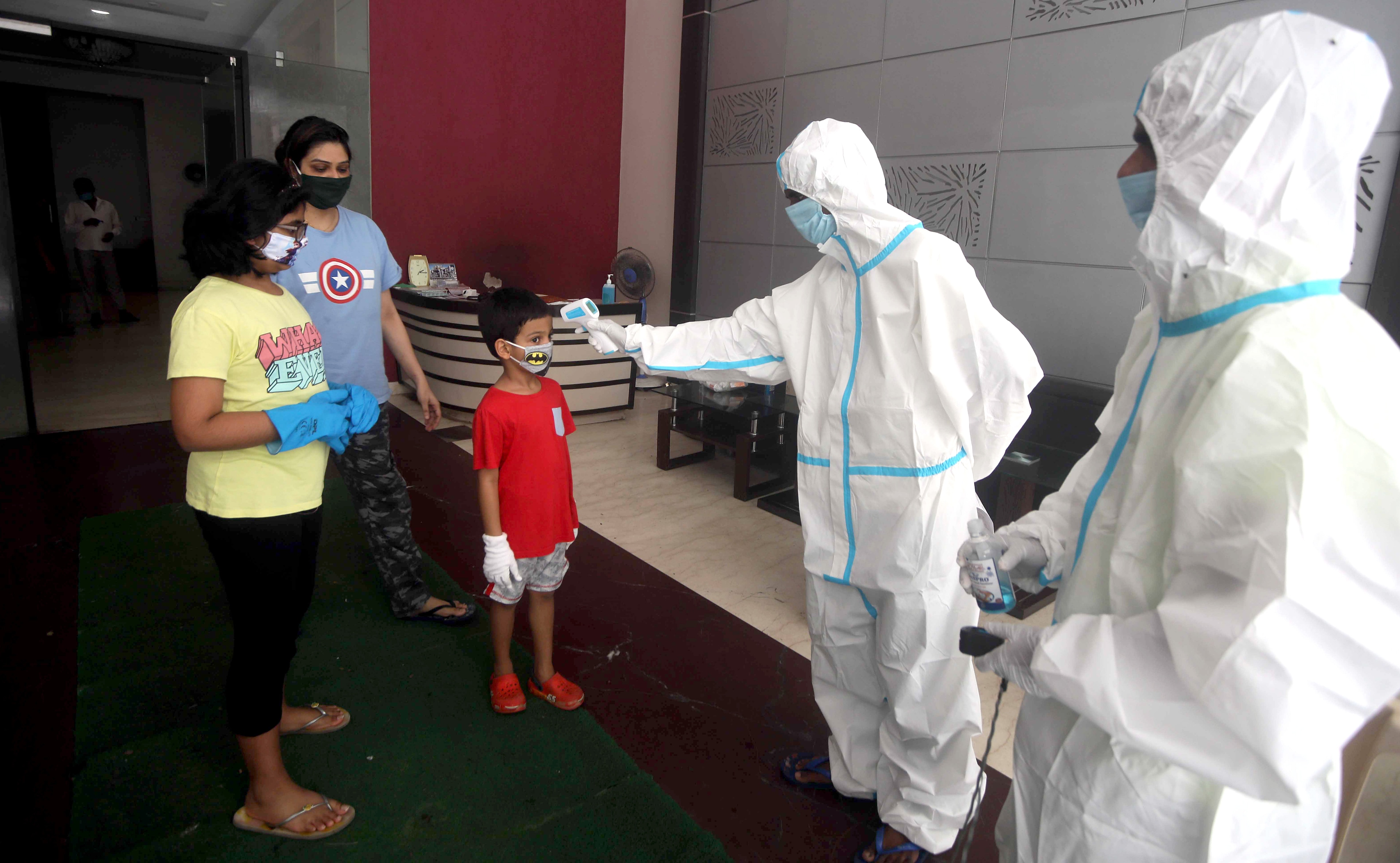

The global tally of confirmed coronavirus cases stands at 14.6 million, of which roughly 5.3 million are currently active, 609,531 patients have lost their lives in the pandemic till now, while 8,752,107 have made successful recoveries. The US is still the worst affected country in the world, with over one-fourth of all reported cases in the world.

In India, there are now over 1 million cases, of which 390,459 are currently active. As many as 27,497 patients have succumbed to the virus, while 700,086 managed to beat the infection. The national capital is the only state among the worst-affected ones to have bent the curve successfully.

Here are some data points on the pandemic:
#1. Daily new cases outnumbering new recoveries in India
In a worrying trend, the gap between daily new cases and daily new recoveries is increasingly growing. In the past two weeks, new cases have grown from roughly 24,000 cases a day to 40,000. However, daily new recoveries have remained stagnant, staying between 19,000 to 23,000 in a day.

#2. Maharashtra added almost 10,000 fresh cases in a day
Maharashtra, the worst-affected state with almost 30 per cent of the country’s total case count, added over 9,000 cases on July 20. This is the highest ever single-day spike for the state and is almost twice the number of cases added on the first day of the month. Maharashtra has over 300,000 cases, of which roughly half are active at present. The state’s death toll stands at over 11,000.


Friday, June 19, 2020

How Trump's 'game-changer' drug is boosting nationalism in Brazil and India


HCQ has now been removed by the US Federal Drug Administration's list of drugs approved for use against Covid-19, yet both India and Brazil continue to recommend its use as a treatment.


As Covid-19 spread around the world in early 2020, hydroxychloroquine (HCQ), an anti-malaria drug touted as a miracle cure by the US president Donald Trump, triggered a global, polarised debate with significant geopolitical impacts.

The debate around HCQ in the United States was widely covered in international English-language media, but the controversy swirling around the same drug in Brazil and India — two countries where partisanship is equally as rife — has received less attention.

The countries deployed drastically different responses to the Covid-19 pandemic. India declared a national lockdown on March 25, while Brazil never instituted one. In both countries, however, the HCQ debate quickly became a useful rhetorical lever to push nationalist positions. Even as HCQ's efficacy remained unproven, its use was aggressively touted by Brazilian president Jair Bolsonaro and Indian prime minister Narendra Modi.

HCQ has now been removed by the US Federal Drug Administration's list of drugs approved for use against Covid-19, yet both India and Brazil continue to recommend its use as a treatment.

Brazil and India have plenty in common. Both are middle-income economies and large democracies that have elected far-right nationalist leaders in the past decade. Modi and his Bharatiya Janata Party (BJP) have galvanized support around Hindu-nationalist sentiment in an attempt to raise India’s profile as an international powerhouse. Brazil elected Bolsonaro president in 2018 on a platform that blended tough-on-crime-and-corruption rhetoric with hardline cultural conservatism and ultra-liberal economic policy that promised sweeping labor and environmental deregulation.


Wednesday, June 10, 2020

Explained: How Covid-19 pandemic upended 20 million lives in Mumbai


Although the coronavirus pandemic's toll has been much lower, there are grim parallels.


When the bubonic plague arrived on ships in 1896, death and fear emptied half of Mumbai. Ensuing labour shortages devastated the city’s cotton mills, the mainstay of the contemporary economy.

Although the coronavirus pandemic’s toll has been much lower, there are grim parallels. Almost a million workers who built Mumbai’s skyline — from the Trump Tower to skyscrapers owned by global firms such as Blackstone Group LP on erstwhile mill land — have fled to their native villages, short of money after a stringent government lockdown brought the economy to a standstill.

A plague-era law is being used to draft doctors into the coronavirus fight, and calls are increasing to decongest infection hotspots including Asia’s most crowded slum.
A megapolis of about 20 million, few cities face the reckoning around labor and life that Mumbai must now contend with. When authorities resumed some public transport on Monday, television channels showed dozens of people rushing to board a bus, a sign of how desperate residents are to return to their livelihoods even as the city remains India’s Covid-19 epicenter.

Six Mumbaikars, as the city’s residents are known, share how the virus has changed their lives and workspaces:

The Union Leader:
J R Bhosale, 79, has seen a lot during his six decades with Mumbai’s railways. A labor strike in 1974 — the world’s largest recorded industrial action — suspended services for 20 days and terrorist bombs in 2006 kept trains quiet for 24 hours.

Yet, under the lockdown, passenger services have been halted for more than two months. Authorities are concerned about the risk of contagion because on a typical day trains run so crowded that latecomers would hang out of doorways.

Monday, May 25, 2020

Bengaluru airport introduces 'contactless journey' to contain Covid-19


According to the BIAL, the features include pre-entry process, where the passengers have to wear masks and carry e-boarding or printed passes


The Bengaluru airport management is introducing a unique feature of parking-to-boarding contactless journey for the passengers as the domestic flight resumes from Monday.

In order to contain coronavirus transmission among passengers and staff, the Bangalore International Airport Limited (BIAL) introduced the new feature of contactless journey right from pre-entry check to security check and boarding.
"Contactless would be the buzzword at the Kempegowda International Airport, Bengaluru when operations resume from May 25," the BIAL said in a statement on Sunday.

With a greater emphasis on minimum touch and minimum exposure between passengers and airport personnel, BIAL aims to minimise all physical contact at the airport.


The technology will continue to enable a seamless airport journey, with greater emphasis on health and safety, the statement said.
"We have introduced innovative contactless procedures to minimise exposure at the airport," Hari Marar, managing director and chief executive officer of BIAL, said. "These enhancements demonstrate our continued commitment to keep our passengers safe in this environment."

I am doing fine after taking a two-week course of hydroxychloroquine: Trump


Trump has spent weeks pushing the drug as a potential treatment or prophylaxis for Covid-19 against the cautionary advice of many of his administration's top medical professionals.


President Donald Trump says he's doing fine after taking a two-week course of an unproven malaria drug for Covid-19.

Trump was addressing his disclosure last week that he was taking hydroxychloroquine and a zinc supplement.

He said the regimen was meant to help prevent infection after two White House staffers tested positive for the coronavirus.

Trump has spent weeks pushing the drug as a potential treatment or prophylaxis for Covid-19 against the cautionary advice of many of his administration's top medical professionals.


Speaking in an interview aired on the Sunday news program Full Measure with Sharyl Attkisson, Trump said that "I just finished the course of drug treatments and to the best of my knowledge, here I am. If it's something that helps, that's all I want."

Monday, May 18, 2020

Can states dilute Lockdown 4.0 guidelines? No, says Home Ministry


Inside the red and orange zones, containment and buffer zones will be identified by the district administration and local urban bodies.


The Home Ministry said on Monday that state or Union Territory can not dilute the guidelines issued for the fourth phase of nationwide lockdown that will continue till May 31.

In a communication to the chief secretaries of the states and Union territories, Union Home Secretary Ajay Bhalla said the guidelines for the fourth phase of the lockdown were issued after taking the views of the states, following a video-conference held by Prime Minister Narendra Modi with chief ministers on May 11.

"As emphasised in my earlier letters, I would like to reiterate again that States and Union Territories cannot dilute restrictions imposed vide the aforesaid guidelines issued by MHA. States and UTs, based on their assessment of the situation, may prohibit certain other activities in various zones, or impose such restrictions as deemed necessary."

"I would urge you to ensure compliance of the new guidelines and direct all concerned authorities for their strict implementation," Bhalla said in his letter to the chief secretaries on Sunday night," the letter read.

Bhalla said under the new guidelines effective from Monday, the states and Union territories will categorise "red", "orange" and "green" zones taking into consideration the revised guidelines issued by the Ministry of Health and Family Welfare on Sunday.
Inside the red and orange zones, containment and buffer zones will be identified by the district administration and local urban bodies with technical inputs at the local level and by taking into consideration the health ministry guidelines.


Thursday, May 14, 2020

Airbus exploring restructuring plans, job cuts due to Covid-19: Report


For now, Airbus is relying on government-backed furlough schemes in France, Germany and Britain to reduce staff costs after earlier asking employees to take 10 days' leave.

Airbus is exploring restructuring plans involving the possibility of "deep" job cuts as it braces for a prolonged coronavirus crisis after furloughing thousands of workers, industry sources said, though no decision is imminent.

Europe's largest aerospace group has not ruled out layoffs while signalling that no decisions will be made before the summer. But a global airline crisis has gathered speed in recent weeks, with carriers and suppliers pleading for help.

Chief Executive Guillaume Faury is expected to update managers on Thursday after warning staff last month that the firm's survival was at stake due to a slump in demand.
Under French law, Toulouse-based Airbus cannot disclose restructuring plans internally before consulting trade unions through a formal exercise not expected before the end of May. But people close to the company said senior staff would be attempting to read between the lines of Faury's weekly internal briefing to gauge his job plans.
"Over the last few weeks, Airbus has implemented a number of financial, operational and social measures in order to adapt to the severe health and economic impact of the Covid-19 crisis," an Airbus spokesman said.

"The company will continue to take all necessary measures to ensure the future of Airbus in cooperation with its social partners."

A meeting with unions is scheduled for Thursday to discuss progress on furlough schemes, French union sources said. More temporary furloughs could be announced in the coming week.

One insider said any restructuring plan would involve forced redundancies and cutbacks were expected to be deep, though others cautioned it was too early to talk of specific numbers.

Tuesday, May 12, 2020

Air passenger traffic to stay below 25% in September: Boeing CEO


Asked whether there might be a major US carrier that has to go out of business, Calhoun said: "Yes, most likely. You know, something will happen when September comes around".


Boeing Chief Executive Dave Calhoun does not expect passenger traffic to reach even a quarter of its levels in September, creating the need for airlines to make "adjustments" as they weather the impact of the coronavirus pandemic.

In an interview with NBC to be aired on Tuesday, Calhoun said: "Traffic levels will not be back to 100%. They won't even be back to 25%. Maybe by the end of the year, we approach 50%. So there will definitely be adjustments that have to be made on the part of the airlines."


Asked whether there might be a major US carrier that has to go out of business, Calhoun said: "Yes, most likely. You know, something will happen when September comes around."

In response to Calhoun's comment, Boeing spokesman Gordon Johndroe said: "He was speaking to the general uncertainty in the sector, not about anyone particular airline."

Monday, May 11, 2020

WHO denies report claiming China pressurised it to withhold Covid-19 info


German weekly Der Spiegel reported that Xi asked Tedros during the call to hold back information about human-to-human transmission of the virus and delay declaring a pandemic.


The World Health Organisation has dismissed a media report saying that it withheld information about Covid-19 following pressure from China, and termed it as 'false allegation'.

The UN agency said in a statement late Saturday that a German magazine's report about a telephone conversation between WHO chief Tedros Adhanom Ghebreyesus and Chinese President Xi Jinping on January 21 was unfounded and untrue.

Weekly Der Spiegel reported that Xi asked Tedros during the call to hold back information about human-to-human transmission of the virus and delay declaring a pandemic. The magazine quoted Germany's foreign intelligence agency, BND, which declined to comment on Sunday.

Der Spiegel also claimed that the BND concluded up to six weeks of time to fight the outbreak had been lost due to China's information policy.

ALSO READ: Coronavirus LIVE

WHO said Tedros and Xi have never spoken by phone and added that such inaccurate reports distract and detract from efforts to end the Covid-19 pandemic. It added that China confirmed human-to-human transmission of the new coronavirus on January 20.
WHO officials issued a statement two days later saying there was evidence of human-to-human transmission in Wuhan, but more investigation was necessary.


Friday, May 8, 2020

Cognizant net income declines 17%; to hire 20,000 at entry-level in 2020


The company is aiming to invest in business and would onboard around 20,000 entry-level executives in 2020.

Teaneck-based IT major Cognizant has reported a decline of 16.78 per cent in net income at $367 million for the quarter ended March 31, 2020, as compared to $441 million in the same period a year ago.

The company is aiming to invest in business and would onboard around 20,000 entry-level executives in 2020.

Its revenue grew by 2.8 per cent to $4.22 billion during the quarter compared to $4.11 billion a year ago, after a negative 50 basis points impact from the exit of certain content services business it had announced earlier.

The company said that the Covid-19 related disruption reduced revenue in March, reflecting delays in project fulfilment while the company shifted to work-from home capabilities.

The highest growth in revenue during the quarter came from Communications, Media and Technology, which grew 5.2 per cent to $626 million. Financial services and healthcare, which contribute around 34.3 per cent and 28.3 per cent of its revenues, grew by 1 per cent and 2.5 per cent, respectively. Products and resources grew 4.4 per cent to $954 million.

Growth in banking was driven by the contribution of the previously announced partnership with three Finnish financial institutions to transform and operate a shared core banking platform and regional banks in North America.

Tuesday, May 5, 2020

Israeli research team gets a step closer to developing a Covid-19 vaccine


The Israel Institute for Biological Research has completed the development phase of Covid-19 antibody.


As researchers and medical labs are stepping up their efforts to find a cure for Covid-19, the Isreal Defence Ministry said in a statement that the Israel Institute for Biological Research (IIBR) has completed the development phase of coronavirus antibody or passive vaccine, reports The Jerusalem Post.

The Israeli defence minister was briefed by the research team, who told that this antibody attacks the virus and neutralises it in the body. The institute is now preparing to get a patent for the antibody and contract for its commercial development. The defence ministry of Israel will coordinate this with the IIBR.

“I am proud of the Biological Institute staff, who have made a major breakthrough,” Defence Minister Naftali Bennett said Monday. “The Jewish creativity and ingenuity brought about this amazing achievement.”

Last month, IIBR told that it had begun testing the antibody-based vaccine prototype on rodents. The institute is also involved in plasma collection from people who have recovered from the novel coronavirus infection, hoping that this might help research.
A second Israeli research team, MigVax, has also reported that it is close to completing the first phase of development of a coronavirus vaccine. Last week, it secured a $12 million investment from OurCrowd to accelerate the path to clinical trials.

Israel has tested over 404,000 samples in the country and 16,246 came out positive. The country has reported 235 deaths till now.

Monday, May 4, 2020

36% Indian firms considering salary freeze over Covid-19 lockdown: Report


The report said that 23 per cent organisations have suspended the promotion increases and 18 per cent organizations deferring or delaying salary increases.


With businesses and economic activity almost halted for over a month now amid the coronavirus crisis and the nationwide lockdown, around 36 per cent companies in India are considering a freeze in salary hikes to manage their costs, according to a report by Korn Ferry.

In India, the most commonly implemented measures for rewards and benefits are promotion and salary hike.

The report said that 23 per cent of organisations have suspended promotion increases and 18 per cent have deferred or delayed salary increases.

The Korn Ferry report said: "36 per cent of organisations have implemented or are considering implementing a salary freeze to manage costs."

The report by the global organisational consulting firm noted that given the government's extensive requests on avoiding laying-off employees, majority of the companies, around 84 per cent have not implemented or are not currently considering permanent staff layoff or redundancies.


Commenting on the survey, Roopank Chaudhary, Client Partner, Korn Ferry India said: "Given the current circumstances and uncertainties on the recovery for market conditions, business leaders are trying everything to survive this storm and manage their costs."

"Among the dozens of ways organisations are taking are layoffs, hiring freezes, reduced hours, less reliance on contractors, reducing overtime, delaying bonuses or merit increases, suspending certain benefits like retirement savings/capital accumulation programs, and many others", he said.

Friday, April 24, 2020

Gilead disputes report of anti-viral drug remdesivir failing Covid-19 trial


It comes days after another report of rapid recovery in fever and respiratory symptoms in some patients with Covid-19 who were treated with remdesivir at the University of Chicago Medicine hospital.


A closely-watched Gilead Sciences Inc experimental antiviral drug failed to help patients with severe Covid-19 in a clinical trial conducted in China, but the drugmaker said the findings were inconclusive because the study was terminated early.

Gilead shares closed down 4.3% after the data was inadvertently released and first reported by the Financial Times. It comes days after another report detailed rapid recovery in fever and respiratory symptoms in some patients with Covid-19 - the sometimes deadly respiratory illness caused by the coronavirus - who were treated with remdesivir at the University of Chicago Medicine hospital.

Interest in Gilead's remdesivir has been high as there are currently no approved treatments or preventive vaccines for Covid-19, and doctors are desperate for anything that might alter the course of the disease that attacks the lungs and can shut down other organs in extremely severe cases.

In the Chinese trial remdesivir, given by intravenous infusion, failed to improve patients' condition or reduce the pathogen's presence in the bloodstream, according to draft documents published accidentally by the World Health Organization (WHO).
But details were thin and suggested limitations in interpreting the data that has not yet been fully reviewed.

A screenshot of the WHO posting, captured by the medical news website STAT before it was taken down, said the trial enrolled 237 patients with 158 receiving remdesivir compared with 79 who got a placebo.

The rate of death was similar at 13.9% for remdesivir versus 12.8% in the control group.


Friday, April 17, 2020

India coronavirus dispatch: A time for brave and imaginative action


From caring about the Indian migrant, to getting the containment strategy right, and when one could get infected from food - read these and more in today's India dispatch.


Here is a round-up of important articles on Covid-19 from across Indian publications – from caring about the Indian migrant, to getting the containment strategy right, and when one could get infection from their food.

Expert Speak
Now is the time to show india cares about its migrants: Benoy Peter, an expert on internal migration, and executive director of Centre for Migration and Inclusive Development, a Kerala-based non-profit, says in this interview that this might be the time for India to show it cares about its migrant workers. He suggests the country should immediately take measures like ensuring food and decent living conditions, testing for Covid-19, and explaining properly to workers in their own language the intricacies of this virus.

Citizens Under Lockdown
Locked down and forgotten in Mumbai: The protest by thousands of stranded migrants at Mumbai’s Bandra railway station on Tuesday evening was yet another reminder of how the nationwide lockdown had been hardest on the poorest among us. It also exposed holes in the government’s repeated claims that it had been providing food and other essentials to those who needed it most. Read more here.

Don’t push yourself to excel in BYJU’S and Duolingo: People are trying new things during the Covid-19 lockdown but it is a problem if they pressure themselves to master those hobbies in these stressful times. Finding time to finally do something you always wanted to is indeed a productive, self-improving and satisfying way of spending time in isolation. Read here why it’s vital to realise that one doesn’t have to come out of this pandemic prim, proper, with a degree in hand and a new language on the lips.

Opinion
A long haul, spend wisely, but don’t skimp on the truly needy: The biggest worry right now is that a huge number of people will be pushed into dire poverty or even starvation by the combination of the loss of their livelihoods and interruptions in the standard delivery mechanisms. Nobel laureates Amartya Sen and Abhijit Banerjee, and former RBI Governor of India Raghuram Rajan explain why as part of the commitment to not miss the needy, there has to be funding available for state and local governments to find effective ways of reaching those suffering from extreme deprivation. If there was ever a challenge that required brave and imaginative action, this has to be it.


Friday, April 10, 2020

India coronavirus digest: Why we need a greater decentralisation of power


From risks posed by discarded medical waste, to why a strong scientific workforce is our best insurance against adversity, read these and more in today's world coronavirus digest.


Here is a roundup of articles from news publications on how India is dealing with the Covid-19 pandemic — from the risk posed by discarded medical waste to sanitation workers, to federal limitations, and why a strong scientific workforce is our best insurance against adversity.

Citizens Under Lockdown
Sanitation workers at risk from discarded medical waste related to Covid-19: Sanitation workers and rag pickers are at risk from handling unmarked medical waste emerging from homes where Covid-19 patients are quarantined, medical experts and waste management specialists have warned. Discarded masks, gloves and tissues could be potential sources for the spread of this highly contagious virus, they have said.

Lockdown making you restless? Chances are you have cabin fever: Being cooped up in our homes for as long as we have is bound to stir up negative emotions. If you too are experiencing it, you might have cabin fever. Here are some steps that you can take to fight off this distress and irritability.

Long Reads
Neglected frontline workers need coronavirus safety gear: In Maharashtra, the worst-affected state, nurses, sanitation workers, and community health workers say they do not have adequate protection from virus exposure. Despite the high level of precaution that they have been asked to exercise, workers have not received any personal protective equipment from hospitals. Such equipment – masks, gloves, face shields, gowns and goggles – is needed to prevent exposure to the coronavirus.

Opinion
Needed, greater decentralisation of power: A crisis of the kind that Covid-19 has wrought will show us that India needs a greater decentralisation of power, and that administration through a single central executive unit is unsuited to its diverse and heterogeneous polity. We cannot continue to regard the intricate niceties of our federal structure as a nettlesome trifle.


Thursday, April 2, 2020

World coronavirus dispatch: US unemployment rises, job cuts at airlines


From the US' plan to ban domestic flights to layoffs at aviation firms and Russia's extended restrictions and fresh wave of coronavirus cases in China - read these in today's international dispatch.


The coronavirus situation seems to have battered the US, with the number of infections in that country crossing the 200,000-mark rather quickly. Piling on to its worries is growing joblessness. New data show that the number of Americans applying for unemployment benefits more than doubled to 6 million – a new record.

Let’s look at the global statistics:

Total confirmed cases: 962,977

Change over the previous day: 88,896

Total deaths: 49,180

Total recovered: 202,728

Nations hit with most cases: US (216,768), Italy (110,574), Spain (110,238), China (82,431), and Germany (80,641).

Source: Johns Hopkins Coronavirus Research Center

US may ban domestic flights
US President Donald Trump has said he is looking “very strongly” at banning domestic air travel to curb the spread of coronavirus but added that he is conscious that it will damage the US airline industry. He will announce his recommendations soon. Read more here.

Credit crisis in emerging markets
Investors are bracing for an emerging market credit crisis as the economic fallout from the coronavirus pandemic hits vulnerable countries. Commodity prices have plunged and demand has frozen, and currencies are tumbling against the dollar. This has particularly hit emerging markets in Africa, Asia and South America.

India coronavirus dispatch: Why we must prepare for the long haul


From a proposal for future lockdowns, to mapping of coronavirus hotspots, and how the civil society can aid government response to Covid-19 - read these and more in today's India dispatch.


Here is a roundup of articles from news publications in India on how the country is dealing with the Covid-19 pandemic — from a proposal for future lockdowns, to mapping of coronavirus hotspots, and how the civil society could aid government response to Covid-19.

Expert Speak
How Covid-19 will hit India: Why is India at such a grave risk from the coronavirus? What are the different ways in which the rural and urban India are likely to be affected? And what has the disease laid bare about the long-term consequences of insufficient health systems? Read this interview with epidemiologist and economist Ramanan Laxminarayan, who directs the Center for Disease Dynamics, Economics, and Policy in Washington, DC.

Citizens Under Lockdown
Lockdown causing further shortage at blood banks: The situation at blood banks has worsened during the lockdown, with hospitals making do with fewer employees, and fewer donors coming forward due to restrictions on people’s movement and the fear of contracting Covid-19 at a hospital or clinic. Read more on how hospitals and patients are managing this crisis.

Exodus shows essential role migrants play in functioning of Indian cities: Most migrant workers live in cramped rented rooms or must sleep on the footpath, lack documents to access benefits such as rations in the city, do not have family members in the city, and have little savings to draw upon. Read this interview with Tariq Thachil, associate professor at Vanderbilt University, on India’s migrant labourer during a lockdown.

Long Reads
Covid-19 – Are we ready for the long haul? Policymakers must be prepared to provide relief to adversely affected individuals. Read this proposal, which details a comprehensive approach for a combination of in-kind transfers and cash support to be provided to all households with ration cards, during any lockdown that takes place over the next 24 months.

Sunday, March 29, 2020

Shanghai tops world's IPO league table despite coronavirus outbreak


Eight companies raised $2 billion that month and a further 5 deals in March were worth $615.5 million.


Shanghai has topped global initial public offering (IPO) league table for the first time in nearly three years, even as the coronavirus epidemic which originated in China rocked markets around the world.

A total of 33 companies raised $7.31 billion floating on the Shanghai main board and the city's start up-focused STAR market, according to Refinitiv data for the first quarter, easily outstripping New York's Nasdaq where 17 companies raised $5.13 billion via IPOs.

But even as Shanghai basks in success, for cash-seeking companies and their bankers the question is whether China can maintain this momentum as the coronavirus continues to cause massive disruption in global financial markets.

While Shanghai hosted the $4.4 billion IPO of Beijing-Shanghai Speed Railway early in January, accounting for most the funds on the main board, STAR market issuance held up even as the country went into virtual lockdown in February.

Eight companies raised $2 billion that month and a further 5 deals in March were worth $615.5 million.


China's markets have fared better than many Western benchmarks, with the blue-chip CSI 300 down 9.4% for the year as of Friday March 27, compared with tumbles of 21% fall for the S&P 500 in New York and 25% for the pan-European STOXX 600 index.

EY Greater China IPO practice leader Terence Ho said the fiscal response from China's government - which accelerated a massive programme of economic stimulus measures - could help boost the prospects of companies looking to list on the mainland markets.

New York state's coronavirus death toll surpasses 1,000 in 16 days


The virus and the disease it causes, coronavirus, has torn through New York with frightening speed.


New York state's death toll from the coronavirus outbreak climbed Sunday above 1,000, less than a month after the first known infection in the state.
Most of those deaths have come in just the past few days.

New York City reported in the evening that its toll had risen to 776. The total number of statewide deaths isn't expected to be released until Monday, but with at least 250 additional deaths recorded outside the city as of Sunday morning, the state's total fatalities was at least 1,026.

The virus and the disease it causes, COVID-19, has torn through New York with frightening speed.

The first known infection in the state was discovered March 1 in a health care worker who recently returned from Iran. Two days later, the state got its second case, a lawyer from the suburb of New Rochelle.


By March 10, Gov. Andrew Cuomo had declared a containment area in New Rochelle that shuttered area schools and houses of worship. That same day, the metropolitan area saw its first fatality: a man who worked at a harness track in Yonkers and lived in New Jersey.

By March 12, the state had banned all gatherings of more than 500 people, darkening Broadway theaters and sports arenas. A day later, the first New York resident died, an 82-year-old woman with emphysema.
New York City Mayor Bill De Blasio closed New York City's schools March 15.

Wednesday, March 18, 2020

Covid-19: Centre asks banks to delay declaring companies' accounts as NPAs


FIEO President Sharad Kumar Saraf said that the spread of Covid-19 to over 144 countries points to the most challenging times for the exports sector.


Centre should ask banks to delay declaring companies' accounts as NPAs for one year due to the economic fallout of COVID-19, the Federation of Indian Export Organisations (FIEO) said.

FIEO President Sharad Kumar Saraf said that the spread of Covid-19 to over 144 countries points to the most challenging times for the exports sector.

"Banks may be asked to delay the declaring companies' accounts as NPA for 1 year as the lack of business coupled with fixed cost will make many accounts NPAs," he said in a statement.

"The existing working credit limits of exporters with the banks may be automatically enhanced by 25 per cent, if so desired... All existing Export Promotion Schemes must continue till March 31, 2021 at least."

He said that as per current trend, MSMEs particularly in employment intensive sectors like carpets, handicrafts, apparels, footwear, gems and jewellery, marine and perishable, with their major market in Europe and the US are likely to be worst affected particularly in first quarter of FY 2020-2021.