Showing posts with label migrant workers. Show all posts

Tuesday, May 26, 2020

Delhi govt issues guidelines for domestic travel: All you should know


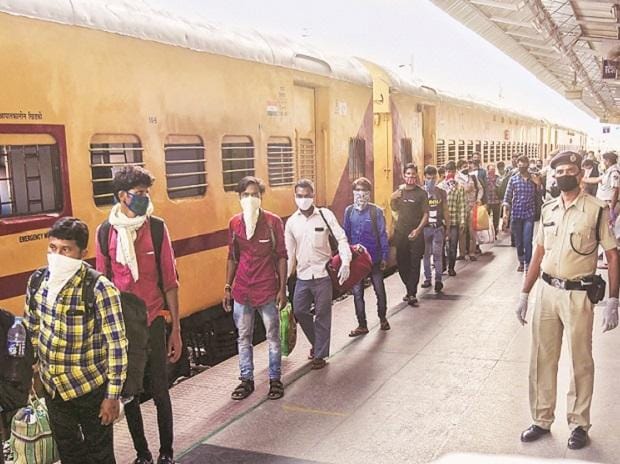
Some trains to ferry stranded migrants and others have already started running while domestic air services resumed from Monday.

The Delhi government on Monday issued guidelines for domestic travel -- air/train/interstate bus -- in the wake of coronavirus outbreak.

According to the guidelines, asymptomatic passengers will be permitted to go with advice that they shall self monitor their health for 14 days. In case, they develop any symptoms, they shall inform the concerned Delhi Disaster Management Authority (DDMA) or state helpline number.

"All passengers shall be advised to download the Aarogya Setu app on their mobile devices. Those having moderate or severe symptoms will be admitted to dedicated Covid health facilities. Those having mild symptoms will be given the option of home isolation or isolated in the Covid Care Centre, both public and private facilities," the guidelines said.


Some trains to ferry stranded migrants and others have already started running while domestic air services resumed from Monday after two months. The Railways will operate 200 passenger trains from June 1.

Meanwhile, the DDMA directed all District Magistrates to appoint a Sub-Divisional Magistrate (SDM) level officer as nodal officer with a sufficient number of team members for facilitating home isolated persons, with a dedicated mobile number in each district.


Tuesday, May 5, 2020

Lockdown 3.0: Political slugfest breaks out on migrant workers' rescue


Sonia Gandhi's move forces central government to bear 85% of cost of migrant travel, states to bear 15%.


It took a nuanced decision by the Congress to make the Central government clear its position on paying for migrant workers’ train journeys back home.

Ending its ambivalence on transporting them on Shramik Special trains during the lockdown, the Union government on Monday said their travel was free and the cost for it would be shared by the Centre and the states.

This was after the government came under political pressure, with Congress President Sonia Gandhi instructing the state units of the party to bear the cost of such rail travel.
Gandhi criticised the railways’ move to donate to the PM’s corona fund, while continuing to charge the migrants.


“When our government can recognise its responsibility by arranging free air travel for our citizens stranded abroad, when the Government can spend nearly Rs 100 crore on transport and food etc. for just one public programme in Gujarat, when the Rail Ministry has the largesse to donate Rs 151 crore to the PM’s Corona fund, then why can’t these essential members of our nation’s fabric be given a fraction of the same courtesy, especially free rail travel, at this hour of acute distress?” she said in her letter.

Starting May 1, labourers were being charged sleeper-class fares of superfast trains and an additional Rs 50 to send them to their destination.


Sunday, April 26, 2020

Coronavirus impact: 60% firms run at less than 25% capacity, says CII


The movement of workers and raw materials remain key hurdles to resuming businesses despite the government allowing major chunks of the industry to operate.


Crippled by lack of inputs, funds and key information, 60% of firms are operating at less than a quarter of their full capacity, with just 10 per cent managing plant utilisation at over 50 per cent, a survey by the Confederation of Indian Industry (CII) shows.

The movement of workers and raw materials remain key hurdles to resuming businesses despite the government allowing major chunks of the industry to operate, the survey has pointed out.

Conducted on April 24, the survey shows that businesses consider getting permits for enterprises to restart, passes for daily travel of workers and establishing earlier supply chains, as their biggest headaches. For sectors allowed to function, 46 per cent of surveyed enterprises say permits are either not


provided or are delayed. The CII has recommended that approvals of applications must have clear deadlines with a provision for automatic permits after the specified time.

“For facilitating restart of economic activities, the CII has suggested that in non-containment zones, businesses should be allowed to function without requirement of permits and only through intimation to local authorities. Workers can be permitted to commute on the basis of a letter issued by the employer organisation, with the facility to travel on own vehicles,” said Chandrajit Banerjee, director general of CII.


Monday, March 30, 2020

Coronavirus: Labourers' exodus throws supply chain, production out of gear


Indian kitchens, particularly in the country's cow belt, cannot be run without atta (wheat flour) required to make roti (bread).


As grocery stores, across the country, are grappling with panic buying and dwindling supplies of fresh stocks, the exodus of labourers have added more fuel to the fire by affecting the entire supply chain of essential commodities, ranging from wheat flour to pulses and biscuits to edible oils.

Majority of grain markets are shut, oil and rice mills are operating with minimum workforce, and truck operators are finding it difficult to move fast moving consumer products (FMCG) across the cities, mostly sealed during the nationwide 21-day lockdown. If the situation aggravates, the country might witness hoarding of goods and price rise of several items.

Despite the efforts of Central as well as state governments to ensure proper supply of FMCG and other essential goods, the fear of COVID-19 pandemic is keeping away the labourers and workers from working in the mills and factories.

"The coronavirus fear has affected the production. Nearly 80 per cent of dal mills are inoperative due to unavailability of labour and supply of raw material. Though the government has now allowed plying of trucks, still issues with transportation remains," says Suresh Agarwal, of All India Dal Mills Association adding, "even as authorities have allowed truckers to operate, the police of different states, particularly on the borders creates hindrance in transporting goods."

Obviously in weeks to come, supply of different varieties of pulses, an essential part of the diet, could be crippled. "But if labour gets back to work, and transport issues are quickly sorted out, the supplies could be smoothen, thus maintaining a balance between supply and demand," hopes Suresh Agarwal. Some varieties of Arhar was quick to disappear from shelves of local grocery stores in Delhi.

"There was a panic buying on the eve of the lockdown on 25 March. I somehow managed to procure stock of Arhar and atta (flour) through a local trader. But things are getting difficult now," said owner of the Sanjay Stores in Vasant Kunj, a large residential area close to Delhi Airport.