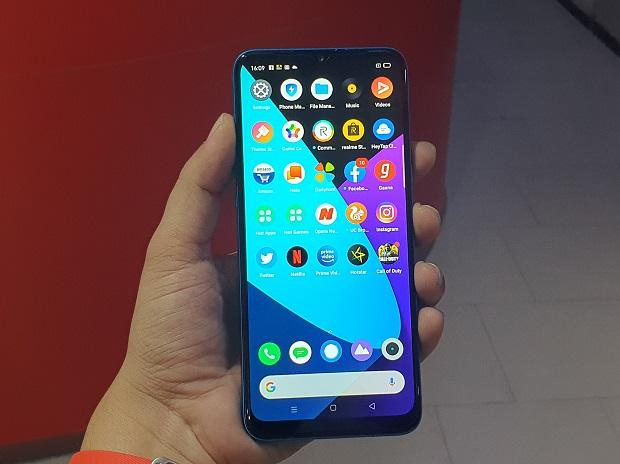
Showing posts with label REALME. Show all posts

Wednesday, May 20, 2020

Realme Smart TV and Realme Watch features unveiled before launch on May 25


The Realme Smart TV and Realme Watch will be part of company's AIoT products ecosystem, which will get around 20 products under tech-lifestyle category this year.


Chinese smartphone brand Realme is set to foray in consumer electronics segment with the launch of its first smart television on May 25. Besides, the company will also introduce its first full-sized smart wearable, the Realme Watch. Both the products will be part of company’s AIoT products ecosystem, which will get around 20 products under tech-lifestyle category in this year. While there is still time for the official unveiling, home-grown e-commerce platform Flipkart has already published the products landing pages with information on products' key features.

Realme Smart TV
The Realme Smart TV is touted to feature a bezel-less design for immersive TV viewing experience. The TV will feature Chroma Boost Picture Engine, which is touted to push its screen brightness up to 400 nits from standard 250 nits. The brightness boost indicates that the Realme Smart TV will support HDR10.
Realme has a long-standing partnership with MediaTek – the company’s first phone was powered by a MediaTek processor. The Realme Smart TV is another of the company’s products to use MediaTek system-on-chip. It will be a 64-bit quad core processor featuring ARM Cortex-A53 cores, paired with Mali 470 MP3 graphic processing unit.

The television’s acoustic will be handled by a quad-speaker set-up of a rated output of 24W. It is still to be seen if this output is per channel, per unit, or for the entire set-up combined. The speakers will be tuned for Dolby Audio for surround sound experience, especially while watching supported content on over-the-top platforms like Netflix and Amazon Prime Videos. The television will ship with Android TV platform with support for voice commands.

Realme Watch
This is going to be a new addition to company’s health and fitness wearable line-up, which the company introduced late last year with the launch of Realme Band (review). Named Realme Watch, the wearable does not promise smartwatch capabilities. However, the Flipkart’s landing page hints that the product would be quite a capable one. It will feature a large 1.4-inch colour touchscreen with customisable home screens and watch faces. The watch will be introduced in three colours – blue, red and green. It will have replaceable straps, which will come in two designs – classic and fashion.


Thursday, February 27, 2020

IQOO 3 first Impressions: This 5G smartphone has something for all


A simple glance at the specifications makes it clear that iQOO plans to make it big and better right from the start rather than aiming at the already cluttered mid-range segment.


Technology News : iQOO is the latest player in the Indian smartphone market, and it has started with a bang with its 5G smartphone iQoo 3 that sports a combination of powerful specifications and notable features that brings it in direct competition with OnePlus smartphones and Realme X50 Pro 5G.

We got our hands on the device and here are the first impressions:
Specifications
The 5G version of iQoo 3 comes with 12GB of RAM and 256GB of storage. The key highlight of the phone is the Qualcomm Snapdragon 865 chipset. This is an octa-core SoC manufactured using a 7nm process with Kryo 585 cores backed by Adreno 650 GPU. The smartphone also supports the latest UFS3.1 storage and LPDDR5 RAM.

A simple glance at the specifications makes it clear that iQOO plans to make it big and better right from the start rather than aiming at the already cluttered mid-range segment.

Design and display
It has a 6.44-inch AMOLED display with a tiny hole-punch on the top right. The full-HD+ resolution has good viewing angles. The bezels are very slim that makes the viewing experience better. The iQoo 3 also comes with 90Hz refresh rate display.

Coming to the build quality iQOO 3 is solid and slightly bulky with 214gm weight, but the curved metal frame makes it easy to hold. The phone has a premium feel to it, considering the overall look and even the camera module at the rear complements the design language.

There is a 3.5mm headphone socket on the smartphone at the top, it adds to the convenience of those who still prefer wired earphones. The USB Type-C port and the loudspeaker are at the conventional bottom position but what's unusual is that the SIM tray that can accommodate two Nano-SIMs, is also at the bottom.

The power and the volume buttons are positioned on the right of the frame and they are easily within the reach of the fingers even when you use the phone single-handedly. There is a dedicated button on the left for a virtual voice assistant. The right frame also has pressure-sensitive buttons that come handy for gaming.

The rear panel has Corning Gorilla Glass 6 protection to prevent scratches.

Friday, February 7, 2020

Realme C3 first impressions: Some noteworthy improvements over Realme C2


Realme's recently-launched budget phone Realme C3 has brought some notable hardware and software upgrades to the Realme C2.


Chinese smartphone brand Realme recently launched the Realme C3 budget smartphone, with some notable software and hardware upgrades when compared with the Realme C2. At a starting price of Rs 6,999 for the 3GB+32GB storage configuration, and Rs 7,999 for the 4GB + 64GB variant, the Realme C3 comes with MediaTek's Helio G70 Processor chipset, 6.5-inch mini-drop full screen with Corning Gorilla Glass 3 protection, and a whopping 5,000-mAh battery.

Realme C3 runs the new Realme UI on top of the Android 10-based ColorOS 7.
The phone has a dual-camera module at the back, with a 12MP primary camera and a 2MP depth sensor. The phone also has a 5MP selfie camera with features like Chroma Boost, slow motion video, HDR mode, and Panorama selfie.

The Realme C3 comes in 3 GB and 4 GB RAM and 32 GB and 64 GB storage variants. The phone also supports dual sim and has a USB port for charging, besides a 3.5 mm jack and speaker at the bottom.

The phone brings some major upgrades to the Realme C2. It has a 6.5-inch mini-drop display, compared with the predecessor’s a 6.1-inch HD-plus dewdrop display. While the Realme C2 had MediaTek Helio P22 chipset, the C3 comes with MediaTek's Helio G70 chipset. In terms of battery, the C2 had 4,000mAh, and the C3 has a 5,000mAh battery. Also, Realme has done away with the diamond-cut design seen in the previous phone; the C3 comes with a back panel that is resistant to smudges and fingerprints.

The Realme C3 is available in Blazing Red and Frozen Blue colours. The first sale of the Realme C3 is scheduled for February 14 at noon (IST).

terms of size and weight, the Realme C3 is easy to handle. The volume and power buttons are well within reach for single-hand use. So far, the phone comes across as a great improvement over the Realme C2, but it remains to be seen if it can be a threat to other phones in the price range.

So far, we liked the overall look and performance, however, it will be too early to pass a verdict.

We will soon gauge the Realme C3’s performance on several important parameters in our full review.

Monday, September 16, 2019

Vivo Z1x review: One of the best bets in the mid-range smartphone segment


At Rs 16,990 for the base model with 6GB RAM and 64GB internal storage, the Vivo Z1x is seemingly one of the best-performing smartphones in the mid-range segment with a 48MP primary camera in tow.


Business Standard : The camera-backed midrange smartphone space had never been so interesting. On Realme has spiced up the game with the launch of the Realme XT (review), which has a whopping 64-megapixel camera, Vivo’s new offering in the Z-series, with a 48-megapixel camera, has only added to delight and confusion.

Business Standard reviewed the Vivo Z1x. Here is how the phone fared on key parameters:

Design
Gradients have become common these days, but the Z1x, thankfully, is an exception. It reflects various shades of the same colour. We had the Phantom Purple variant and the colour scheme looked fine. Its glossy finish made it shine but also attracted fingerprints and smudges.

Vivo Z1x The frame is polycarbonate; a glass back would have been better. The panel is flat, making the phone easy to hold. Even though single-handed operation is a bit difficult, the phone still fits in the hand easily.

The volume and power buttons are on the right, and a dedicated button for Google Assistant and dual nano-SIM card tray is on the left. All the buttons are within reach of your fingers.

The phone weighs 189.6 gms. Though not the lightest, it is not feel bulky — something I felt when using the phone for clicking photographs while riding pillion on a motorbike.
The overall build quality may not have been too desirable for some, but it’s a good change from the common curved look. The flat panel also makes it less slippery.

Display
The 6.38-inch full-HD Plus (1,080 x 2,340 pixels) super AMOLED display, with a 19.5:9 aspect ratio and a 90 per cent screen-to-body ratio, delivers a fine viewing experience. The bezels are minimal on the sides and top but a bit thick at the bottom.

The in-display fingerprint sensor works fine. The colours look a bit dull but the brightness can be adjusted to make it look all clear. The display may not look very crispy but the brighter side is that it doesn’t put much pressure on the eye to adjust to the screen.
The screen is ideal for binge-watching, though. The overall experience on Netflix and Amazon Prime was good. The volume output is decent, so you can rely on the phone’s sound even if you don’t have earphones or headphones.

Thursday, August 8, 2019

Realme to launch three phones with quad rear cameras; one with 64MP sensor


Realme announced that the company is planning to upgrade its mobile phones in Realme, Realme Pro and Realme X series with quad camera modules before Diwali.


Chinese electronics manufacturer BKK Electronics’ smartphone brand Realme on August 8 announced that the company is planning to upgrade its mobile phones in Realme, Realme Pro and Realme X series with quad camera modules before Diwali. Interestingly, one of the phones with a new quad camera module will sport a 64-megapixel primary sensor (GW1) sourced from Samsung. This is the same sensor that another Chinese mobile phone maker Xiaomi is touting to bring in one of its Redmi-branded smartphone by the end of this year.

While the company did not provide any specifics related to the upcoming quad camera modules, it presented several photographs apparently captured through a new camera set-up that hint at what to expect from the upcoming smartphones. The photographs showcased had a variety of shots; some taken in diverse lighting conditions hinting at possible enhancements with regard to low-light photography. Other samples include ultra-wide shots and macro shots, which were apparently taken through dedicated lenses. A telephoto lens for 2x optical zoom would also be a part of the package.

Besides, the company also provided insights on the 64MP camera. This camera will use Samsung ISOCELL Bright GW1 sensor (S5KGW1), which has a pixel size of 1/1.72-inch and tetracell technology for clearer pictures in all light conditions. Explaining the technology behind sensor, Dr Manish Goel, principal engineer, SSIR, System LSI business, Samsung said, the tetracell technology uses re-mosaic algorithms capturing details even in bright light conditions. In low-light, the sensor merges four adjacent pixels together to create one big pixel resulting in brighter photos. The sensor also has hardware optimised smart-ISO that auto controls resulting in low noise and higher detailing.

While the future of smartphone imaging seems promising, especially for affordable and midrange phones, it is still debatable to judge camera performance based on its sensor’s megapixel count. In past, search engine and technology giant Google has shown that a lot can be done and achieved through software optimising. In about time we will know if a camera with higher megapixel count delivers improved performance or if it is just a marketing gimmick.

Business Standard

Tuesday, March 19, 2019

Realme 3 review: Decent budget phone marred by weak multimedia capabilities


On paper, the Realme 3 seems to be a feature-rich proposition. However, like any other phone, it has its strengths and weaknesses. Let's take a look at how the phone fares in real life scenario.


Business Standard : Chinese smartphone brand Realme recently introduced the Realme 3, a successor of company’s affordable performance-centric smartphone, the Realme 2. Pitched to be a competitor of the Xiaomi Redmi Note 7 and Samsung Galaxy M10 (review), the Realme 3 has decent hardware, dual camera module on the back, gradient starry design, and waterdrop notch screen.

On paper, the phone seems to be a feature-rich proposition. However, like any other phone, it has its strengths and weaknesses. Let’s take a look at how the phone fares in real life scenario:

Design and display
The Realme 3 ditches the diamond cut pattern that was introduced by the company in most of its previous devices. However, it compensates the design change with a new starry gradient pattern profile covering the entire back. The rear panel curves all the way to the sides around the frame and meets the glass on the front. It is made of multiple laminated layers that give it a glass-like glittery profile.

Though the phone’s back panel with gradient starry design looks dazzling, it is prone to smudges and is a fingerprint magnet, therefore, needs regular cleaning. Thankfully, the phone comes with a silicone case that fits perfectly and saves the phone body from accidental scratches.

The Realme 3 has a 6.2-inch screen of HD+ resolution. The screen sports dew drop notch on the top, accommodating front camera. The screen looks vivid, but falls short on brightness, leading to average sunlight legibility. Unfortunately, the phone does not support Widewine L3 certification required to stream video content in high-resolution from over-the-top platforms such as Netflix and Amazon Prime Videos. Therefore, the screen looks pixelated while streaming videos and shows online.

Performance and battery
The phone is powered by MediaTek Helio P70 system-on-chip (SoC), paired with 3GB of RAM and 32GB of storage or 4GB of RAM and 64GB of storage. The phone boast dedicated storage expansion slot, which supports microSD card of up to 256GB. Though the phone falls short in rendering HD multimedia content, it handles graphic intensive games such as PubG and Asphalt 9 well. The phone does show thermal issues as it gets warm after extensive gaming sessions.

In handling average day to day tasks, the phone feels sleek and snappy. It shows no lags while browsing the internet with multiple tabs open and handling multiple apps active in background. The phone boots Android 9 Pie-based ColorOS 6.0, which is a heavily customised user interface that might not please everyone.

Sunday, March 3, 2019

Realme 3 will be Flipkart-exclusive: To be launched at noon today


Along with the Realme 3, the company might also unveil the Realme 3 Pro, which was recently teased by the company on Twitter.


Chinese smartphone maker Realme will launch the Realme 3 phone in India on Monday. The company has been teasing the device on its social media platforms, confirming some of the features and specifications. Interestingly, a recent tweet also hints at the Realme 3 Pro edition, which might launch with the Realme 3.

Besides a gradient design, which has been part of most Realme devices, the Realme 3 will be powered by a MediaTek Helio P70 system-on-chip (SoC) and a 4,230 mAh battery. This SoC is built on TSMC’s 12NM FinFET technology and features an octa-core set up, which includes four ARM Cortex-A73 cores of a maximum operating frequency of 2.1GHz and four ARM Cortex-A53 cores of a maximum operating frequency of 2.0GHz.
The SoC has a dedicated ARM Mali-G72 MP3 graphic processing unit to handle graphics. The SoC also supports artificial intelligence (AI) computing, suggesting the Realme 3 would use it at least to enhance the phone’s imaging.

Any guesses? pic.twitter.com/AAHoCvUf9w
Realme (@realmemobiles) February 27, 2019

The Flipkart-exclusive phone would feature a waterdrop-shaped notch screen on the front and a starry gradient design on the back. Besides a rear mounted fingerprint sensor, the phone is expected to sport a dual camera set-up at the back. Though the phone would be powered by a healthy 4,230 mAh battery, it is to be seen if it is capable of charging fast.

Make your life bright and colourful with #realme3. #shotonrealme #PowerYourStyle #DualCamera pic.twitter.com/zSmtyLIT5P
Realme (@realmemobiles) February 28, 2019


Tuesday, February 12, 2019

Xiaomi leads India smartphone market, OnePlus tops premium segment in 2018


Xiaomi, Samsung, Vivo, Realme and OPPO emerged as the top five smartphone vendors in terms of market share in Q4 2018 in India.


Chinese brand Xiaomi with 28.9 per cent market share led the Indian smartphone market in 2018, followed by South Korean brand Samsung at 22.4 per cent and Vivo at 10 per cent, an International Data Corporation (IDC) report said on Tuesday.

"The premium end of the market outgrew all other price segments in 2018 with 43.9 per cent Year-on-Year (YoY) growth -- OnePlus emerged as the leader in the price segment range $500-$700 and in the super premium segment and Samsung surpassed Apple for the top position with its Galaxy S9 series," said Upasana Joshi, Associate Research Manager, Client Devices, IDC India.

According to the report, the online-focused brands drove the online channel share to an all-time high of 38.4 per cent in 2018 and a whopping 42.2 per cent in 2018 Q4 whereas offline channels had a rather muted year with a modest 6.7 per cent annual growth and a 5 per cent sequential growth in Q4.

"Shipments form Xiaomi, Asus, OnePlus and more grew online channels resulted by 47.3 per cent YoY in Q4, but the offline channel was unable to keep pace with the deep discounts and go-to-market initiatives from the e-tailers almost throughout the year," Joshi added.

The overall smartphone average selling price remained flat in 2018 at $158, with high shipments in the mass segment of $100-$200 -- which accounted for more than half of the smartphone market in India.

Xiaomi, Samsung, Vivo, Realme and OPPO emerged as the top five smartphone vendors in terms of market share in Q4 2018 in India.

On the other hand, the feature phone market, primarily driven by Jio Phones -- which makes up 56 per cent of the total mobile phone market clocked 181.3 million-unit shipments in 2018, with 10.6 per cent YoY growth, the report said.

Article Source BS

Monday, September 24, 2018

Realme 2 Pro with 8GB RAM, waterdrop notch-based screen to launch on Sep 27 


Realme 2 Pro, scheduled to be unveiled in India on September 27, is confirmed to use Qualcomm Snapdragon 660 SoC and be the first Realme phone to get an 8GB RAM variant.


Chinese smartphone brand Realme recently separated from Oppo and launched the Realme 2 in India at a starting price of Rs 8,990. At the launch, the company also announced its plans to launch a Pro edition. The Realme 2 Pro, scheduled to be unveiled on September 27 in India, is expected to be major upgrade.

Based on the teasers shared by the company on its social media platforms, the Realme 2 Pro is expected to get a waterdrop design notch-based screen, unlike the wide notch screen in the Realme 2. The phone is also confirmed to get a dual camera module on its back. However, the lens configurations are not yet confirmed.

A recent teaser also confirmed that the smartphone would get an 8GB RAM variant. Powering the device would be a Qualcomm Snapdragon 660 system-on-chip (SoC) with artificial intelligence capabilities.

The Realme gradient design has been one of the key differentiating factors in the company's smartphones.

However, the Realme 2 Pro is expected to trade off the gradient design language for a regular glass build. The phone is expected to have a design similar to that of the Oppo F9 Pro, which also has a waterdrop design screen. However, to maintain the differentiating factor, the Realme 2 Pro would feature a regular glass back, instead of the gradient design glass back seen in the Oppo F9 Pro.

By comparison, the recently launched Realme 2 sports a 6.2-inch fullHD+ screen with a notch, accommodating the selfie camera, earpiece and sensors. The phone is powered by Qualcomm Snapdragon 450 SoC, mated with either 3GB or 4GB of RAM and 32GB or 64GB of internal storage, respectively. The phone has a dual-camera module on its back, featuring a 13-megapixel primary sensor, paired with a 2MP depth-sensing lens.

In terms of design, the Realme 2 has a glass body with a metallic chassis. The glass back has Realme’s gradient design that the company introduced with the Realme 1 last year. The phone is priced at Rs 8,990 for the base model with 3GB of RAM and 32GB of internal storage, and 10,990 for the 64GB/4GB variant.

Article Source Business Standard

Monday, August 27, 2018

Realme 2 Mobile Phone India launch Today: Watch livestream, know specs, features & price


Realme 2 would sport a gradient design, similar to the first-generation device. However, compared to predecessor, it would feature a new format screen, better internals and an improved camera module.


Realme, a sub-brand of Chinese smartphone manufacturer Oppo is launching the second iteration of its value-for-money smartphone in India today ( August 28). Named the Realme 2, the smartphone would have a gradient design, similar to the first-generation device.

However, compared to the predecessor, the upcoming smartphone will feature a new format screen, better internals and an improved camera module, according to a device listing page on the e-commerce platform Flipkart.

The Realme 2 would sport a 6.2-inch HD+ resolution screen with a notch, accommodating a front camera, earpiece and sensors.

On the back, the phone would get a dual camera module placed horizontally on top left centre, along with an LED flash. The back would also feature a fingerprint sensor, which was missing in the predecessor.

However, like the predecessor, the Realme 2 would feature a diamond-shaped gradient design on the back and on the frame.

In terms of specifications, the Realme 2 would be powered by a Qualcomm Snapdragon processor. However, there is no confirmation on the details of processor and RAM/ROM configurations.

Imaging would be taken care of by a dual-camera module on the back that is expected to feature a 13-megapixel primary sensor, mated with a 2MP depth-sensing lens for bokeh and portrait shots. Selfie camera is expected to feature an 8MP lens of f/2.0 aperture size. Powering the smartphone would be a 4,230 mAh battery.

The Flipkart-exclusive smartphone is expected to be priced under Rs 10,000 for the base model. The phone is launching in India at 12:30 PM today.

Article Source BS