Showing posts with label NASA. Show all posts

Monday, June 8, 2020

Elon Musk tells SpaceX staff to make Starship rocket 'top priority'


In an internal email accessed by CNBC, Musk urged SpaceX employees to accelerate progress on its next-generation Starship rocket.


Elon Musk has told his SpaceX staff to make Starship spacecraft top priority and speed up progress on the super-heavy rocket marred by turbulent testing in recent months.
In an internal email accessed by CNBC, Musk urged SpaceX employees to accelerate progress on its next-generation Starship rocket.

Starship is the heaviest rocket for space tourism and long-distance trips and represents a truly reusable rocket with fast turnaround times that make spaceflight more accessible.

But the Starship prototype has faced four failed tests since the project began late last year.

"Please consider the top SpaceX priority (apart from anything that could reduce Dragon return risk) to be Starship," Musk wrote in the email over the weekend.
Marking the beginning of a new era in the US space programme, the SpaceX Crew Dragon spacecraft carrying NASA astronauts Robert Behnken and Douglas Hurley successfully docked with the International Space Station (ISS) on May 31.

SpaceX is developing Starship with the goal of launching as many as 100 people at a time on missions to the moon and Mars. "We need to accelerate Starship progress," Musk said.

"For those considering moving, we will always offer a dedicated SpaceX aircraft to shuttle people," he added.

In April, a prototype of Starship 'SN3' broke apart during a pressure test at the company's test site in Boca Chica, Texas. The explosion happened as liquid nitrogen was being poured into the rocket's propellant tanks.

Monday, December 2, 2019

Meet Shanmuga Subramanian: The Chennai techie who helped find Vikram debris 


Shanmuga Subramanian, who made the discovery said, 'It was something challenging as even NASA can't find out so why can't we try out?'


A space enthusiast from Chennai who worked independently, found a debris from the Vikram moonlander that scientists had been looking for and helped guide them to the spot where it had crashed.

Shanmuga Subramanian, who made the discovery, told IANS on Tuesday: "It was something challenging as even NASA can't find out so why can't we try out? And that's the thought that led me to search for Vikram lander."

He looked for it on the images from NASA's Lunar Reconnaissance Orbital (LRO) Camera that the US space agency had released to the public.

LRO Project Scientist Noah Petro told IANS: "The story of this really amazing individual (who) found it, helped us find it, is really awesome."

He said that Subramanian "is totally independent of the LRO, totally independent of the Chandraayan 2 team, just someone who is very interested in the Chandraayan 2 mission (who) used our data and identified a spot where there was a change that we had not identified".

"He went through the image, looking pixel by pixel and found that spot," Petro added.
Subramanian works in Chennai as a software architect and told IANS in an email interview that he did the search in his spare time.

The first mosaic image of the likely crash site made from pictures taken by the LROC on September 17 was downloaded by several people to look for signs of the Vikram, NASA said.

NASA and the LRO project scientists said at that time they could not locate Vikram because the are it had crashed in was in deep shadows.
But not Subramanian.
Petro said that he and the LRO camera team head received an email from Subramanian about his finding and that was used to help identify the spot where Vikram crashed.


Thursday, September 26, 2019

Vikram had hard landing; NASA releases images of Chandrayaan 2 landing site 


Vikram was scheduled to touch down on September. 7. This event was India's first attempt at a soft landing on the Moon.


NASA on Friday released high-resolution images captured by its Lunar Reconnaissance Orbiter Camera (LROC) during its flyby of the lunar region where India's ambitious Chandrayaan 2 mission attempted a soft landing near the Moon's uncharted south pole, and found Vikram had a hard landing.

The Vikram lander module attempted a soft landing on a small patch of lunar highland smooth plains between Simpelius N and Manzinus C craters before losing communication with ISRO on September 7.

"Vikram had a hard landing and the precise location of the spacecraft in the lunar highlands has yet to be determined, NASA said.

The scene was captured from a Lunar Reconnaissance Orbiter Camera Quickmap fly-around of the targeted landing site image width is about 150 kilometres across the centre.
Vikram was scheduled to touch down on September. 7. This event was India's first attempt at a soft landing on the Moon. The site was located about 600 kilometres from the south pole in a relatively ancient terrain, according to the US space agency.

The LRO passed over the landing site on September 17 and acquired a set of high-resolution images of the area; so far the LROC team has not been able to locate or image the lander.

LRO will next fly over the landing site on October 14 when lighting conditions will be more favourable, John Keller, Deputy Project Scientist Lunar Reconnaissance Orbiter Mission, Goddard Space Flight Centre, told PTI via email.

"It was dusk when the landing area was imaged and thus large shadows covered much of the terrain; it is possible that the Vikram lander is hiding in a shadow. The lighting will be favourable when LRO passes over the site in October and once again attempts to locate and image the lander," NASA said.


Monday, July 22, 2019

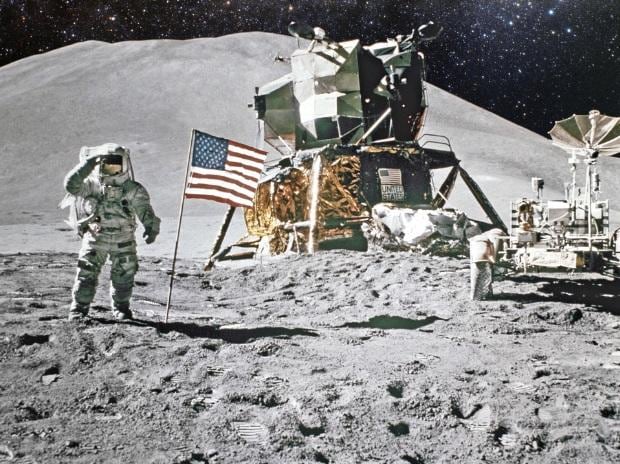
Apollo 11 made us believe we could do anything, but it could hasten our end


This faith in technology has given us a false sense of security.


The Apollo project gave us the astonishing spectacle of a blue marble rising over the sterile surface of the moon. Of course, the moon was already known to be uninhabitable. But being shown something in high-resolution colour photography makes a stronger impression than being told it by the experts. Our planet appeared in the photos as a small, vulnerable object amid surroundings utterly inimical to life. They showed, in a way that no scientific report could, the importance of keeping the Earth habitable, boosting the environmental movement.

Keep Reading : Business Standard

But the moon landings affected many people in precisely the opposite way. No other public project has been such a spectacular success. The aim was so simple and concrete that everyone could immediately grasp it. Kennedy’s commitment to “landing a man on the moon and returning him safely to the Earth” was made before the US had even put a man into orbit. Yet it was achieved just eight years later – barely half the time it takes nowadays to build a new railway across London. “Top that,” the Americans can easily say. Fifty years on, no one has.

The trouble with spectacular successes is that they breed complacency. The moon landings reinforced the belief that technology will always be able to solve our problems. Everyone knows the saying, “If we can put a man on the moon, surely we can…” All we need is the will to do it. And a lot of money, of course. But not as much as you might think: the entire Apollo programme, over 12 years, cost about £120 billion in today’s money. That’s how much the US spends on its military in 11 weeks (and Britain in three years). If technology can do that, what can it not do?

ALSO READ: 50 yrs of Apollo 11: How geological maps made the moon landings worthwhile

This faith in technology has given us a false sense of security. Every day we hear urgent warnings about antibiotic resistance, soil depletion, deforestation, loss of biodiversity and of course climate change. These imminent catastrophes are the result of our own behaviour. The obvious solution is to change that behaviour: to stop abusing antibiotics, destroying tropical forests, burning fossil fuels, and so on. Yet we don’t.

Part of the reason we don’t is the expectation that technology will save us. If we can put a man on the moon, surely we can develop new antibiotics, replenish the soil and restore the tropical forests. We can stop climate change by building machines to remove greenhouse gases from the atmosphere. (And anyway, we can build walls to keep out the rising seas.) All we need is better politicians.

Friday, July 19, 2019

Women yet to step on moon but well intertwined with it in literature


The moon is often envisaged as a female entity, which inspired poems on the theme of her gaze as she looks down on Earth benignly.


In the late 17th century, the female English playwright Aphra Behn wrote a smash hit play about a man obsessed with the moon, who was constantly travelling there in his imagination. Exactly 282 years later, Neil Armstrong and Buzz Aldrin actually made that dream a reality.

Their astonishing achievement on July 20, 1969 led some to worry that the moon would become an object of purely scientific study – a barren and lifeless body, no longer a source of romantic inspiration. Fortunately, this fear did not come to pass.

For example, in the year that marked the 40th anniversary of the landings ten years ago, the then poet laureate Carol Ann Duffy edited To the Moon: An Anthology of Lunar Poems which gathered together works from ancient to modern, and included her own poem, The Woman in the Moon.

And while no woman has yet stepped on to this celestial body, women have long been associated with the moon – with its tidal pull, and the binary thinking that places it secondary in majesty to the sun. It is no wonder, then, that the moon has stimulated some incredible literature by female writers.

The moon is often envisaged as a female entity, which inspired poems on the theme of her gaze as she looks down on Earth benignly. Way back in antiquity, the Greek poet Sappho did just this in her short song describing how:

When, round and full, her silver face, Swims into sight, and lights all space.
This trope continued for millennia and into the 19th century. Louisa May Alcott (author of Little Women) wrote The Mother Moon in 1856, imagining a benevolent maternal moon looking down on the Earth, occasionally hidden but ultimately undiminished by clouds. Also in the 19th century, American poet Emily Dickinson’s moon similarly shone “Her perfect Face Upon the World below”.


Duffy’s more recent poem contains these familiar elements, being written in the persona of a woman in the moon – one who is incredulous anyone could have believed instead in a man in the moon. The woman in the moon has spent millennia observing Earth and now implores those gazing up at her to reflect on the neglect humans have wrought on planet Earth, repeating the question “What have you done?”

Tuesday, July 16, 2019

One small step for a man': Did we mishear Armstrong's first words on Moon?


Armstrong insisted that he actually said, 'That's one small step for a man.' In fact, in the official transcript, Nasa transcribes the quote as 'that's one small step for (a) man'.


Business Standard : On July 20, 1969, an estimated 650 million people watched in suspense as Neil Armstrong descended a ladder towards the surface of the Moon.
As he took his first steps, he uttered words that would be written into history books for generations to come: “That’s one small step for man. One giant leap for mankind.”
Or at least that’s how the media reported his words.

But Armstrong insisted that he actually said, “That’s one small step for a man.” In fact, in the official transcript of the Moon landing mission, NASA transcribes the quote as “that’s one small step for (a) man.”

As a linguist, I’m fascinated by mistakes between what people say and what people hear.
In fact, I recently conducted a study on ambiguous speech, using Armstrong’s famous quote to try to figure out why and how we successfully understand speech most of the time, but also make the occasional mistake.

Our extraordinary speech-processing abilities
Despite confusion over Armstrong’s words, speakers and listeners have a remarkable ability to agree on what is said and what is heard.

When we talk, we formulate a thought, retrieve words from memory and move our mouths to produce sound. We do this quickly, producing, in English, around five syllables every second.

The process for listeners is equally complex and speedy. We hear sounds, which we separate into speech and non-speech information, combine the speech sounds into words, and determine the meanings of these words. Again, this happens nearly instantaneously, and errors rarely occur.

These processes are even more extraordinary when you think more closely about the properties of speech. Unlike writing, speech doesn’t have spaces between words. When people speak, there are typically very few pauses within a sentence.
Yet listeners have little trouble determining word boundaries in real time. This is because there are little cues – like pitch and rhythm – that indicate when one word stops and the next begins.

How drawing map of the Moon for Apollo became a national priority 


President John F. Kennedy announced that a national goal for the decade was to send a man to the Moon and back safely.


Business Standard : At an International Astronomical Union meeting in 1955, noted astronomer Gerard Kuiper asked for suggestions and collaborators on a project to make a map of the Moon. At the time, the best lunar atlases had hand-drawn images, and Kuiper wanted to use state-of-the-art telescopes to make a photographic atlas.

Only one person responded.
That was indicative of the astronomical community’s general attitude toward the Moon. After all, telescopes were designed to look at distant objects, and the Moon is rather close, and boring as well, since its appearance doesn’t change. Furthermore, Kuiper wanted to make a map, and that’s the sort of thing that geologists, not astronomers, do.

Kuiper proceeded, though, and by 1960, he had moved his small operation to the University of Arizona in Tucson. There he could take advantage of the region’s mountaintops and clear skies, and the university’s willingness to move into a field of study that defied traditional departmental boundaries. The next year, President John F. Kennedy announced that a national goal for the decade was to send a man to the Moon and back safely. Suddenly, the niche pursuit of making maps of the Moon had turned into a national priority.

For the next several years, Kuiper’s Lunar and Planetary Laboratory produced progressively better images of the Moon, using telescopes built for the purpose. Later they used images from robotic spacecraft to the Moon to produce a series of increasingly sophisticated atlases of the lunar surface.

As a child, I was focused on the accomplishments of the astronauts, starting with the day in 1961 that the principal burst into my kindergarten classroom to tell us that Alan Shepard had been launched into space, and culminating in the Apollo 11 landing in 1969.

Like most of us who watched all those missions, I didn’t really expect to go into space science or aerospace engineering. But when I got the chance to study Apollo samples in graduate school, it’s not surprising that I gravitated to them. I eventually spent my career studying rocks from space. Similarly, I didn’t think much about the groundwork that went into mapping the Moon until I ended up at the Lunar and Planetary Laboratory. Once I started learning the stories and talking to those involved, though, I came to appreciate the number of extraordinary things that were done in that era as a result of the political race to the Moon.

Monday, July 15, 2019

Space travel was a dream for artists long before Armstrong stepped on moon 


For centuries, the dream of human travel into the cosmos has fired imaginations.


In the midst of the space race, Hereward Lester Cooke, the former co-director of the NASA Art Program, observed, “Space travel started in the imagination of the artist.”
If the 50th anniversary of the first Moon landing is an opportunity to celebrate a remarkable technological achievement, it’s also a good time to reflect on the creative vision that made it possible.

Long before Neil Armstrong set foot on the Moon, artists and writers were crafting visions of extraterrestrial exploration that would make space flight possible.

Cultivating possibility
For centuries, the dream of human travel into the cosmos has fired imaginations.
Ancient mythologies teemed with deities who suffused the skies, glimmered from stars and rode the Sun and Moon. Pythagoras, Philolaus and Plutarch each contemplated the Moon as a world of its own. Leonardo da Vinci famously imagined flying machines that would take their occupants skyward. Authors such as Cyrano de Bergerac – who’s credited with being the first to imagine a rocket being used for space travel – fed a growing appetite for stories of celestial exploration.

In 1865, the French writer Jules Verne published his novel, “From Earth to the Moon,” followed five years later by its sequel, “Round the Moon.”

Verne’s tale provides an uncannily prescient account of the development of space travel: Three astronauts blast off from Florida in a small aluminum capsule, fired from the end of an enormous cast iron gun. After orbiting the Moon and making observations with a pair of opera glasses, the three men return to Earth, splashing into the ocean as heroes.

Almost a century later, RKO Pictures would release a film inspired by Verne’s adventure story, while a comic book version of the tale went through multiple printings between 1953 and 1971.

In the 1950s, the painter Chesley Bonestell further stoked the imagination of future space-farers with his visions of space stations, published in Collier’s. Walt Disney would follow with three made-for-TV movies that illustrated the ways people might one day be able to fly into space and land on the Moon.

Business Standard

Less support from women in space exploration? Time to change perception


Women have been historically excluded from the space program.


Business Standard : In March 2019, Vice President Mike Pence stated that the goal of NASA should be to return humans to the Moon by 2024. While the cost of such a venture isn’t known yet, NASA Administrator Jim Bridenstine has supported the effort and gone as far as naming the 2024 Moon mission, Artemis.

The selection of Artemis is no mistake. In Greek mythology, Artemis was the sister of Apollo as well as goddess of the Moon. The name also signals a new focus on the role of women in space exploration.

From my perspective as a space policy analyst, this is an important message for NASA to send. Women have been historically excluded from the space program, especially early on. While women have made inroads both as astronauts and more generally within the NASA ranks since, there remains a significant gender gap in support for space exploration.

And for Artemis to succeed in getting the first woman to the Moon by 2024, a lot of political and public support will be required. But a recent AP-NORC poll found there is not a lot of enthusiasm for going back to the Moon. Only 42% of the 1,137 respondents supported the idea, 20% opposed it, and 38% didn’t care either way. NASA’s efforts to reach out to women should help them garner support, but it is by no means guaranteed.

Women in space and STEM
There is a long-recognized gap in the number of men and women who pursue careers in science, technology, engineering and math, with women lagging far behind. Research into this phenomenon has ruled out differences in mental ability. Rather it attributes the gap to the power of stereotypes on young children.

One need look no further than the early space program for evidence of this. The astronauts of the 1950s and 1960s were all men, a natural result of the requirements for astronauts to have a military and test-piloting background. Given that women were not allowed in these fields to begin with, they were excluded.

Some people, like pioneering female pilot Jerrie Cobb and NASA flight surgeon William Lovelace, believed that women were just as capable and perhaps better suited to be astronauts than men. During a House hearing on gender discrimination in NASA, John Glenn, the first American to orbit the Earth, testified to Congress that women didn’t belong in the space program, stating: “The men go off and fight the wars and fly the airplanes and come back and help design and build and test them. The fact that women are not in this field is a fact of our social order.”

Thursday, July 11, 2019

Reality or studio shoot? Why moon landing conspiracy theories still exist 


In the US, opinion polls indicate that between 5-10% of Americans distrust the official version of events.


Business Standard : Bill Kaysing was a former US Navy officer who worked as a technical writer for one of the rocket manufacturers for NASA’s Apollo moon missions. He claimed that he had inside knowledge of a government conspiracy to fake the moon landings, and many conspiracy theories about the Apollo moon landings which persist to this day can be traced back to his 1976 book, We Never Went to the Moon: America’s Thirty Billion Dollar Swindle.

The basic template of the conspiracy theory is that NASA couldn’t manage to safely land a man on the moon by the end of the 1960s as President John F Kennedy had promised, so it only sent astronauts into Earth orbit. Conspiracy theorists then argue that NASA staged the moon landings in a film studio and that there are tell-tale signs on the footage and the photos that give the game away. They claim that NASA has covered up the elaborate hoax ever since.

Moon landing sceptics point to supposed clues such as photos that appear to show the astronauts in front of cross hairs that were etched on the camera glass, or a mysterious letter C visible on a moon rock. These and many other seeming anomalies have been debunked, but moon landing conspiracy theories have persisted in the popular imagination.

In the US, opinion polls indicate that between 5-10% of Americans distrust the official version of events. In the UK, a YouGov poll in 2012 found that 12% of Britons believed in the conspiracy theory. A recent survey found that 20% of Italians believe that the moon landings were a hoax, while a 2018 poll in Russia put the figure there as high as 57%, unsurprising given the popularity of anti-Western conspiracy theories there.

Ready to disbelieve
That Kaysing’s conspiracy theory took hold in mid-1970s America is in large part due to a wider crisis of trust in the country at the time. In 1971, citizens read the leaked Pentagon Papers, showing that the Johnson administration had been systematically lying about the Vietnam War. They tuned in nightly to the hearings about the Watergate break-in and subsequent cover-up.

A series of congressional reports detailed CIA malfeasance both at home and abroad, and in 1976, the House Select Committee on Assassinations concluded – in contrast to the Warren Commission more than a decade earlier – that there was a high probability that there had been a conspiracy to kill Kennedy. These revelations had helped fuel a wider shift in conspiracy thinking since the late 1960s, from a belief in external enemies, such as Communists, to the suspicion that the American state was itself conspiring against its citizens.

Monday, July 1, 2019

50 yrs of moon landing: When the world paused to watch Armstrong's moonwalk


Officially more than 500 million people gathered around their sets to watch him leap from the ladder of Apollo 11's Eagle landing craft and onto the surface of the Sea of Tranquility.


Business Standard : When Neil Armstrong walked on the Moon, he became the biggest live television star in history.

Officially more than 500 million people gathered around their sets to watch him leap from the ladder of Apollo 11's Eagle landing craft and onto the surface of the Sea of Tranquility.

But, as AFP reported at the time, that figure was probably an underestimation.
Experts now believe the real number was closer to 700 million, a fifth of the planet's population at the time.

Next month will mark 50 years since Armstrong's famous phrase -- "That's one small step for man, one giant leap for mankind" -- was heard around the world.
The moment was the culmination of an unprecedented 31-hour live link-up between NASA and major US TV networks.

Armstrong's first steps onto the lunar landscape on July 21, 1969 were followed second-by-second by viewers across the globe, with the notable exception of China and the old Soviet bloc.

Normal life across the planet stopped for those special moments, AFP reported, with Japan's Emperor Hirohito interrupting a ritual walk with his empress to watch it.
The mission was covered in exhaustive detail over a marathon eight days of broadcasts from the last-minute preparations and the lift-off, to the moonwalk and return to Earth.
Some 3,500 journalists followed events at the Mission Control Center in Houston, Texas.
Joel Banow, who was a director for CBS News at the time, said the sheer scale of the event was mind-boggling.

"It was my job to make the programme as exciting as possible. We spent more than USD 1 million on the production, which was astronomical for a news programme in '69," he told Robert Stone in his documentary "Chasing the Moon".

"Some of the ideas I came up with were inspired by science fiction films I saw as a child," he admitted.

In fact, TV channels competed with each other to come up with the most "space age" sets, with some turning to star sci-fi authors such as Arthur C. Clarke, Isaac Asimov and Orson Welles, the director of the radio drama "The War of the Worlds".

Wednesday, June 12, 2019

Rare 'superflares' from Sun could disrupt earth's communications 


Astronomers probing the edges of the Milky Way have in recent years observed superflares -- huge bursts of energy from stars that can be seen from hundreds of light years away.


Superflares erupted from the Sun could disrupt electronics across the Earth, causing widespread black outs and shorting out communication satellites in orbit, scientists warn.
Astronomers probing the edges of the Milky Way have in recent years observed superflares -- huge bursts of energy from stars that can be seen from hundreds of light years away.

Keep Reading : Business Standard

Until recently, researchers assumed that such explosions occurred mostly on stars that, unlike Earth's, were young and active.

Scientists from University of Colorado (CU) Boulder in the US have found that superflares can occur on older, quieter stars like our own -- albeit more rarely, or about once every few thousand years.

If a superflare erupted from the sun, the Earth would likely sit in the path of a wave of high-energy radiation, researchers said.

Such a blast could disrupt electronics across the globe, causing widespread black outs and shorting out communication satellites in orbit.

"Our study shows that superflares are rare events. But there is some possibility that we could experience such an event in the next 100 years or so," said Yuta Notsu, a researcher in CU Boulder.

Scientists first discovered this phenomenon from an unlikely source: the Kepler Space Telescope. The NASA spacecraft, launched in 2009, seeks out planets circling stars far from Earth.

However, it also found something odd about those stars themselves. In rare events, the light from distant stars seemed to get suddenly, and momentarily, brighter.
Researchers dubbed those humongous bursts of energy "superflares."

Notsu explained that normal-sized flares are common on the Sun. However, what the Kepler data was showing seemed to be much bigger, on the order of hundreds to thousands of times more powerful than the largest flare ever recorded with modern instruments on Earth.

"When our sun was young, it was very active because it rotated very fast and probably generated more powerful flares," said Notsu, also of the National Solar Observatory in Boulder.

Tuesday, April 2, 2019

A-SAT missile test created 400 pieces of debris, put ISS at risk: Nasa


Nasa's Jim Bridenstine said about 60 pieces have been tracked so far and out of which 24 are going above the apogee of the ISS.


The NASA on Tuesday termed as a "terrible thing" India's shooting down of one of its satellites that has created about 400 pieces of orbital debris, endangering the International Space Station (ISS).

NASA Administrator Jim Bridenstine said about 60 pieces have been tracked so far and out of which 24 are going above the apogee of the ISS.

"That is a terrible, terrible thing to create an event that sends debris and an apogee that goes above the international space station. That kind of activity is not compatible with the future of human spaceflight that we need to see have happen," he said at a NASA townhall here.

"The ASAT test by India last week has resulted in about 400 pieces of orbital debris," he added.

Bridenstine said not all of the pieces were big enough to track and the NASA is right now tracking objects which are 10 centimeters or bigger.

"Some 60 pieces of orbital debris have been tracked so far, 24 out of which poses risk to the International Space Station," he said.

Bridenstine was addressing employees of the National Aeronautics and Space Administration days after Prime Minister Narendra Modi, in a televised address, announced that India shot down a satellite in space with a missile, catapulting the country into an elite club of space powers alongside the US, Russia and China
Bridenstine is the first top official from the Trump administration to come out in public against the India's ASAT test.

"We are charged with commercialising of low earth orbit. We are charged with enabling more activities in space than we've ever seen before for the purpose of benefiting the human condition, whether it's pharmaceuticals or printing human organs in 3D to save lives here on earth or manufacturing capabilities in space that you're not able to do in a gravity well," he said.

"All of those are placed at risk when these kinds of events happen," Bridenstine said as he feared India's ASAT test could risk proliferation of such activities by other countries.
"When one country does it, other countries feel like they have to do it as well," he said.
"It's unacceptable. The NASA needs to be very clear about what its impact to us is," the NASA Administrator said.


Wednesday, February 13, 2019

A $100-million effort to remove 750,000 pieces of junk that encircle Earth


With an estimated 750,000 bits of old satellites and rockets circling the Earth at about 8 kilometers per second, a collision could instantly shatter a multimillion dollar satellite.


As the satellite industry booms, a Japan-based venture is working to prevent space-debris collisions that could paralyze transport, defense and telecommunications systems.
Astroscale Holdings Inc. is preparing to rendezvous with, capture and dock a test satellite early next year to show how its technology can help clear orbiting junk, Miki Ito, 36, general manager of Astroscale’s Japan unit, said in an interview.

Astroscale is competing in a niche that has drawn urgent attention and funding from companies and governments including those in the U.S., Japan, Singapore and the UK. The venture has raised about $103 million, including money from Japan’s state-backed INCJ Ltd., as it vies with rivals to invent an affordable way to prevent a chain-reaction of collisions known as the Kessler effect.

Astroscale said its mission will be the world’s first in-orbit debris capture and removal demonstration using its rendezvous and magnetic capture mechanisms. In the test run, “chaser” and “target” modules will rocket into orbit, then separate. The chaser will then attempt to capture the target once in a steady state and again when it is tumbling. Once safely docked, the chaser and target will power back toward Earth, burning up on re-entry into the atmosphere.


Given the difficulty of fixing satellites in orbit, there is usually no choice but to bring malfunctioning craft down, said Ito, who worked on microsatellite projects at the Next Generation Space System Technology Research Association before becoming president of Astroscale Japan, then general manager this month.

Astroscale is also planning to raise its workforce to 100 from 60 as it expands to the U.S. and other global markets.

With an estimated 750,000 bits of old satellites and rockets circling the Earth at about 18,000 miles per hour (8 kilometers per second), a collision could instantly shatter a multimillion dollar satellite, as portrayed in the Academy Award-winning 2013 movie “Gravity.” Worse, a chain reaction of destruction could render entire bands of low-earth orbit un-navigable for satellites.

Close Calls
There have already been some close calls. In 2009, the U.S.-launched Iridium33 satellite collided with Russia’s Kosmos-2251, sending thousands of new bits of debris hurtling through space. The crash didn’t immediately trigger other collisions, but the junk is still up there and may yet do so.

Still, the number of satellites being flung into space is soaring. Commercial launches under 500 kilograms are forecast to jump 10-fold to more than 5,600 in the 10 years to 2027, compared with the previous decade, consulting firm Euroconsult estimates in its report on prospects for the small satellite market.

Monday, February 11, 2019

World is getting greener, India and China leading efforts: NASA study


China alone accounts for 25 per cent of the global net increase in leaf area with only 6.6 per cent of global vegetated area.


India and China are leading the global greening effort, which is quite contrary to the general perception worldwide, a latest NASA study said Monday, observing that the world is a greener place than it was 20 years ago.

The NASA study based on data received and analysed from its satellite said that India and China are leading in greening on land. "China and India account for one-third of the greening but contain only 9 per cent of the planet's land area covered in vegetation," said lead author Chi Chen of Boston University.

"That is a surprising finding, considering the general notion of land degradation in populous countries from over exploitation," he said.

The study published on February 11, in the journal Nature Sustainability said that recent satellite data reveal a greening pattern that is strikingly prominent in China and India and overlaps with croplands world-wide.

China alone accounts for 25 per cent of the global net increase in leaf area with only 6.6 per cent of global vegetated area.

The greening in China is from forests (42 per cent) and croplands (32 per cent), but in India it is mostly from croplands (82 percent) with minor contribution from forests (4.4 per cent), the NASA study said.

China is engineering ambitious programmes to conserve and expand forests with the goal of mitigating land degradation, air pollution and climate change.

Food production in China and India has increased by over 35 per cent since 2000 mostly owing to an increase in harvested area through multiple cropping facilitated by fertiliser use and surface- and/or groundwater irrigation.

When the greening of the Earth was first observed, we thought it was due to a warmer, wetter climate and fertilization from the added carbon dioxide in the atmosphere, said Rama Nemani, a research scientist at NASA's Ames Research Center and a co-author of the study.

This study was made possible thanks to a two-decade-long data record from the Moderate Resolution Imaging Spectroradiometer (MODIS) instruments on NASA's Terra and Aqua satellites. Now with the MODIS data, we see that humans are also contributing, she said.
Observing that once people realise there is a problem, they tend to fix it, Nemani said in the 1970s and 80s in India and China, the situation around vegetation loss was not good.