Showing posts with label INDIAN NAVY. Show all posts

Tuesday, January 28, 2020

Cochin Shipyard mulls cautious expansion, to grow ship repair business


air said India should do much more of ship repair, given the country's location and good-quality manpower.


Amid the not-so-good business climate for ship building, state-owned Cochin Shipyard has prepared a cautiously sizable growth plan.

Expansion of the repair business, foray into the volume-based business of fishing boats, and eyeing Indian Navy projects and the private tourism sector are some.

“We are looking to up our ship repair turnover and have moved into profit sharing agreements with both Mumbai and Kolkata port trusts. We see an additional revenue of Rs 70-80 crore from Mumbai alone in FY20 itself. In the next two years, our revenue from the Mumbai port alone should be above Rs 200 crore,” Madhu Nair, chairman and managing director, told Business Standard.

Currently, about 70 per cent of the revenue comes from the ship building business and the rest from ship repair. “We are also investing Rs 80 crore at the Mumbai port for a floating dry dock and Rs 20 crore at the Kolkata port,” said Nair. An agreement is in place between each of the ports and Cochin Shipyard, creating an asset-light model for the latter.

Nair said India should do much more of ship repair, given the country’s location and good-quality manpower.

Cochin Shipyard was also in talks with the Mormugao Port Trust for their ship repair facility but could not take this ahead, due to vessel size limitations. “Between our own repair facility, along with the Mumbai and Kolkata ports, we can now handle large and mid-sized ship repairs. We were, therefore, on a lookout for a small-sized ship repair facility. Goa should have been small but it did not fit,” said Nair.

Though revenue consistently rose between 2014-15 and 2018-19, growth in the ship building business income was not as impressive as in the repair section.
According to the latest annual report, the yard built 20 defence vessels, 15 large vessels, 35 offshore support vessels and 52 small and medium vessels. These figures are unchanged from the preceding year.

Sunday, December 29, 2019

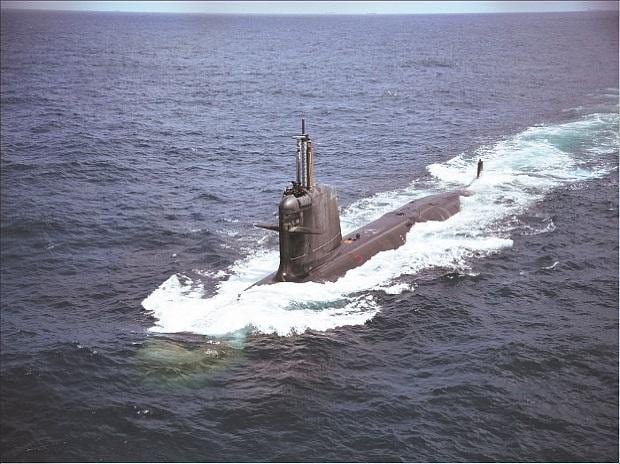
Navy plans to build 24 submarines, 6 of them nuclear powered: Report


In its report tabled this month, the Navy stated that there are presently 15 conventional submarines and two nuclear submarines in its fleet.


To strengthen its underwater fleet, the Indian Navy plans to build 24 submarines, including six nuclear attack submarines, a parliamentary panel was told.

The Navy also told the panel that Medium Refit Life Certification (MRLC) of submarine Sindhuraj has been held up since the Russian side has not been able to submit bank guarantees and integrity pact due to sanctions imposed by the US.

In its report tabled this month, the Navy stated that there are presently 15 conventional submarines and two nuclear submarines in its fleet.

The Indian Navy has two nuclear submarines INS Arihant and INS Chakra, with the latter being leased from Russia.

Majority of the conventional submarines are over 25 years old. Thirteen submarines age between 17 and 32 years, it said.

“Eighteen (conventional) + six SSN (nuclear attack submarines) are planned...,” it stated.
The Indian Ocean Region, the area of operations of the Indian Navy has witnessed rising activities of the Chinese Navy.

On its part, the Indian Navy has been revamping its infrastructure, including procuring new ships.

Business Standard

Tuesday, December 3, 2019

Declining budget: Navy likely to field about 175 warships, not 200


The Navy was allocated Rs 56,388 crore in 2019-20, of which Rs 25,656 crore was for capital expenditure.


Budget 2020 : The chief of naval staff (CNS), Admiral Karambir Singh, has admitted that the Navy’s declining budget has forced him to re-evaluate his long-term plan to field 200 warships by 2027. This target is institutionalised in the Navy’s Maritime Capability Perspective Plan (MCPP) for 2012-2027.

To media queries about how many ships could realistically be expected to be in service by 2027, the Navy’s vice chief, Vice Admiral G Ashok Kumar, replied “about 175”. The CNS, however, termed that figure “optimistic”.

Singh was addressing the media on Tuesday, on the eve of Navy Day. The Navy currently has about 130 warships, he said, and another 50 are under construction in shipyards in and outside the country.

“The Navy’s share of the defence Budget has declined from 18 per cent in 2012 to approximately 13 per cent in the current financial year (2019-20),” stated Singh.
The Navy was allocated Rs 56,388 crore in 2019-20, of which Rs 25,656 crore was for capital expenditure, or the payment for new ships. An estimated 90 per cent of this was already earmarked for paying instalments for warships and equipment purchased in previous years.

“We have projected (our additional requirement) and our hope is that we’ll get some more money. Based on that we will prioritise our requirements so that the maritime interests of the country are not compromised”, said the CNS.

“Acceptance of Necessity (the first step in procurement of military equipment)” has also been accorded for 41 ships, 31 helicopters, 24 multi-role helicopters and six additional P 8I maritime aircraft,” said Singh.

Singh explained that the expected shortage of warships would have to be compensated for by introducing high technology and building more capable warships. “Our aim will be to ensure that we get the maximum bang for the buck and by prioritisation, (improving) networking, and thinking deeper about how to improve the effects (of weapons systems), rather than just bean-counting,” he said. Elaborating on this, Singh said: “But more important is what you pack into your ships. If they’re modern and lethal then you have that much more in terms of effects.”

Business Standard

Tuesday, February 12, 2019

Indian company to build 111 Naval Utility Helicopters for Rs 21,738 crore


The basic SP policy framework is a part of the Defence Procurement Procedure of 2016 (DPP-2016).


The Ministry of Defence (MoD) on Tuesday kicked off the procurement of 111 Naval Utility Helicopters (NUH) for the Indian Navy. This acquisition, estimated to be worth Rs 21,738 crore, is the first one being processed under the new Strategic Partner (SP) procurement model.

The SP model envisages the indigenous manufacture of major defence platforms by an Indian company, which will collaborate with a foreign OEM (original equipment manufacturer) to acquire niche technologies and set up production facilities in India.

With the MoD having green-lighted this acquisition on August 25, an Expression of Interest (EoI) was issued today, inviting potential Indian SPs and foreign OEMs to submit collaborative proposals to build the NUH in India.

“The OEMs have been mandated to set up [a] dedicated manufacturing line, including design, integration and manufacturing processes for NUH in India and make Indian manufacturing line as a global exclusive facility for the NUH platform being offered,” stated the MoD on Tuesday.


The first 16 helicopters can be delivered from the OEM’s overseas production facility, but at least 95 helicopters out of 111 must be manufactured in India by the selected SP. An ambitious level of 60 per cent indigenisation is being aimed at in the NUH project.

The Indian companies aspiring to be SPs have been given two months to respond to the EoI. The MoD expects Tata Advanced Systems Ltd, Mahindra Defence, Adani Defence, Larsen & Toubro, Bharat Forge and Reliance Infrastructure to participate in the process.
“The Indian companies would be shortlisted based on their capability of system of system integration, facility in the aerospace domain and financial capability,” announced the MoD today.

The foreign OEMs have been given three months to respond to the EoI. The MoD says the foreign OEMs likely to participate in the project are Lockheed Martin, Airbus Helicopters, Bell Helicopters and Russian export agency, Rosoboronexport.
The RFP for procurement is likely to be issued towards the end of third quarter of this year to the shortlisted Indian companies.