Showing posts with label GSAT. Show all posts

Thursday, January 16, 2020

India's GSAT-30 satellite successfully launched from French Guiana


After a flight lasting 38 minutes 25 seconds, GSAT-30 separated from Ariane 5 upper stage in an elliptical Geosynchronous Transfer Orbit.


India early Friday launched a communication satellite called GSAT-30 from French Guiana on the northeast coast of South America, aiming to use the space device to improve broadcasting and connectivity in the country.

European space consortium Arianespace's Ariane 5 VA-251 rocket lifted off from Kourou, the launch base, at 2:35 am IST to carry GSAT-30 for the Indian Space Research Organization (ISRO) and the Eutelsat Konnect satellite for the French telecommunications company Eutelsat.

After a flight lasting 38 minutes 25 seconds, GSAT-30 separated from Ariane 5 upper stage in an elliptical Geosynchronous Transfer Orbit.

The satellite will provide communication services to Indian mainland and islands through Ku-band and wide coverage covering Gulf countries, a large number of Asian countries and Australia through C-band,” said ISRO chairman K Sivan in a statement.
GSAT-30 will provide DTH Television Services, connectivity to VSATs for ATM, Stock-exchange, television uplinking and Teleport Services, Digital Satellite News Gathering (DSNG) and e-governance applications.

ISRO’s Master Control Facility (MCF) at Hassan in Karnataka took over the command and control of GSAT-30 immediately after its separation from the launch vehicle. Preliminary health checks of the satellite revealed its normal health.

In the days ahead, orbit-raising manoeuvres will be performed to place the satellite in Geostationary Orbit (36,000 km above the equator) by using its on-board propulsion system.

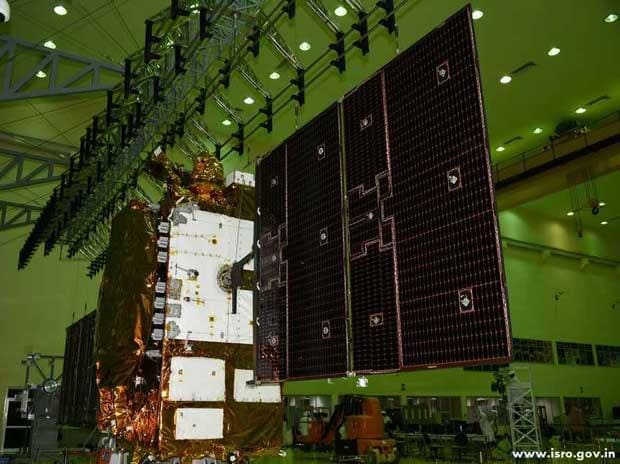
During the final stages of its orbit raising operations, the two solar arrays and the antenna reflectors of GSAT-30 will be deployed. Following this, the satellite will be put in its final orbital configuration. The satellite will be operational after the successful completion of all in-orbit tests.

Business Standard

Tuesday, December 11, 2018

Isro to launch GSAT-7A communication satellite for IAF, Army on Dec 19


The satellite will be placed in the geostationary orbit and this communication satellite is expected to help the IAF interlink different ground radar stations, airbases and AWACS aircraft.


The Indian Space Research Organisation (Isro) is planning to launch a dedicated communication satellite for defence purposes next week.
GSAT-7A is a communications satellite which can be used by the Indian Air Force and the Indian Army.

Isro is all set to launch the communication satellite GSAT-7A on board the GSLV-F11 from Satish Dhawan Space Centre in Sriharikota on December 19, 2018. The satellite will weigh 2.2 tonnes and will be launched by the Geosynchronous Satellite Launch Vehicle (GSLV Mk II) rocket, said Isro.

The satellite will be placed in the geostationary orbit and this communication satellite is expected to help the IAF interlink different ground radar stations, airbases and AWACS (Airborne Warning And Control System) aircraft.

GSAT-7A is the 35th Indian Communication satellite built by Isro. The GSAT-7A spacecraft is configured on Isro’s standard I-2,000 Kg (I-2K) bus. The satellite is built to provide communication capability to the users in Ku-band over the Indian region. Total cost of the GSAT-7A is estimated to be in the region of Rs 6-8 billion and its life is estimated to be around nine years, according to Isro sources.

The satellite will enable the IAF to interlink different ground radar stations, ground airbase and airborne early warning and control (AWACS) aircraft, such as Beriev A-50 Phalcon and DRDO AEW&CS. The satellite will also enhance Network-centric warfare capabilities of the Indian Air Force and therefore enhance its global operations.

GSAT-7A is also expected to give a major push for drone operations as it would help the Navy reduce the reliance on on-ground control stations and take satellite-control of military unmanned aerial vehicles (UAV), which should help boost the range and endurance of the UAVs, said industry experts.

In addition to GSAT-7A, the IAF would also be getting the GSAT-7C in a few years, to boost the network-centric operations.

The GSAT 7 series was launched in 2013 as a dedicated communications satellite for the Indian Navy, which made the Navy completely independent of relying on foreign satellites.

GSAT 7 currently has a 2,000 nautical mile footprint and provides real-time inputs to Indian warships, submarines and maritime aircraft.

According to reports, India has around 13 military satellites, with most of them being remote-sensing satellites like the Cartosat-series and RISAT satellites placed in the near-earth orbit for better scanning of Earth.

However, some of the Indian military satellites are placed in the geostationary orbit. These are used for surveillance, navigation and communication purpose by the armed forces.