Showing posts with label EDUCATION POLICY. Show all posts

Monday, September 9, 2019

Can India's education budget fund increased spending in new policy?


Good public education is a fundamental right in India, and there is a strong correlation between public investment in education, child development and empowerment.


The government’s Draft New Education Policy released May 2019 suggests increasing spending on education from 10% of total government expenditure to 20% by 2030. However, there is no funding available for such an increase in India’s current education budget.

Further, since 2015, government spending on school education has actually decreased after correcting for inflation, according to an analysis of state and central education finances over the years.

Good public education is a fundamental right in India, and there is a strong correlation between public investment in education, child development and empowerment. For instance, states that spent more on education, such as Himachal Pradesh and Kerala, scored higher on the empowerment index, which takes into account attendance levels at primary, upper primary, secondary and senior secondary levels, as well as indicators linked with gender equality such as sex ratio at birth and early marriage.

*Year: Average expenditure on school education for the period 2012-13 to 2018-19
**Note: This is computed by the Centre for Budget and Policy Studies taking six indicators (four relating to education and 2 relating to empowerment, sourced from National Sample Survey Office’s 71st round and National Family Health Survey, 2015-16, respectively)

Central government’s education budget reduced since 2014
Even as the government promises an increase in spending on education, the share of the union budget allocated to education fell from 4.14% in 2014-15 to 3.4% in 2019-20, the period during which the Bharatiya Janata Party headed the central government, according to budget documents from 2014 to 2020. In the 2019-20 budget, the share of the union budget allocated to education remains at 3.4%, which means that, this financial year, the government is not allocating more money to education as the new education policy would require.

It is not only the share that has declined; in case of school education, the budget has decreased in absolute terms. Total money allocated to school education reduced from Rs 38,600 crore in 2014-15 to Rs 37,100 crore in 2018-19, based on the budget’s revised estimates.

Business Standard

Tuesday, June 4, 2019

Explained: The controversy around 3-language policy and 'Hindi imposition'


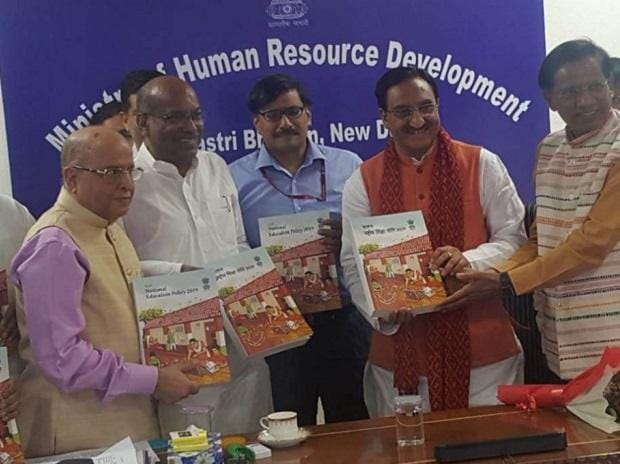
Draft of a new education policy released by the Centre came under fire from Opposition parties who alleged that it proposes to 'impose Hindi' on non-Hindi speaking states.


Draft of a new education policy released by the Centre has made Hindi the centre of a controversy. Among several proposals made in the draft National Education Policy (NEP), the one clause that came under fire was the "3-language formula". The proposal was seen as a move to impose Hindi on non-Hindi speaking states.

The contentious paragraph in the draft has now been revised.

Why the draft NEP led to a controversy?
The draft NEP, uploaded on the HRD Ministry's website on Friday sought to make Hindi a mandatory third language to be taught in schools across the country.

"Students who wish to change one of the three languages they are studying may do so in Grade 6, so long as the study of three languages by students in the Hindi-speaking states would continue to include Hindi and English and one of the modern Indian languages from other parts of India, while the study of languages by students in the non-Hindi-speaking states would include the regional language, Hindi and English," the earlier draft policy said.

The revised draft education policy
After the uproar, the Central government on Monday released a revised draft NEP. The new draft has removed the clause that was seen as imposition of Hindi by several states.
The new draft now states: "In keeping with the principle of flexibility, students who wish to change one or more of the three languages they are studying may do so in Grade 6 or Grade 7, so long as they are able to still demonstrate proficiency in three languages (one language at the literature level) in their modular Board Examinations some time during secondary school."

Why southern states are opposing it?
This is not the first time that the country is witnessing protests against Hindi.
Tamil Nadu had always resisted the "imposition" of Hindi. In 1965, the state witnessed violent protests against a proposal that Hindi would be India's only official language.
The anti-Hindi sentiments in Southern states, especially Tamil Nadu, is not just a language affair. According to a report in The Hindu, imposition of Hindi is seen as the hegemony of the North and the introduction of mono-culture.


Business Standard